Guardian Stone is a free-to-play mobile, fantasy-themed, turn-based RPG built around collecting a large roster of Guardians. It mixes colorful 3D visuals with side-scrolling stages, party-building strategy, elemental matchups, gear upgrades, Guardian evolutions, asynchronous league PvP, and several extra PvE activities designed for farming resources and long-term progression.
 | Publisher: NHN Entertainment Playerbase: Medium Type: Mobile RPG Release Date: January 20, 2016 Shut Down Date: September, 2016 Pros: +Sharp, high-quality 3D presentation. +Large Guardian roster to hunt for. +Thoughtful turn-based battles with planning. +Simple to learn for quick sessions. Cons: -Encounters can start to feel samey. –Heavy emphasis on farming and long grinds. |
Guardian Stone Overview
Guardian Stone is a 3D, side-scrolling, hero-collecting RPG developed by TOAST and published by NHN Entertainment, known for Guardian Hunter and Crusaders Quest. It drops you into a classic fantasy setting packed with familiar threats like orcs, titans, and dragons, then asks you to build a team around one of three hero classes (Warrior, Ranger, or Sorceress). From there, the hook is collecting over 69 Guardians and using them to solve increasingly demanding turn-based fights that lean on cooldown management, skill timing, and an elemental advantage triangle.
Progression is driven by stage clears and steady upgrades. Your hero improves through level-based skill unlocks and equipment upgrades, while Guardians can be enhanced with elemental Runes and pushed further through evolution using elemental Essences. Beyond the main stages, the game also offers league-based asynchronous PvP and multiple PvE dungeons and boss-style challenges that serve as repeatable sources of upgrade materials.
Guardian Stone Features:
- Many Stages to Complete – Work through hundreds of stages spread across multiple regions, with regular boss encounters and changing backdrops.
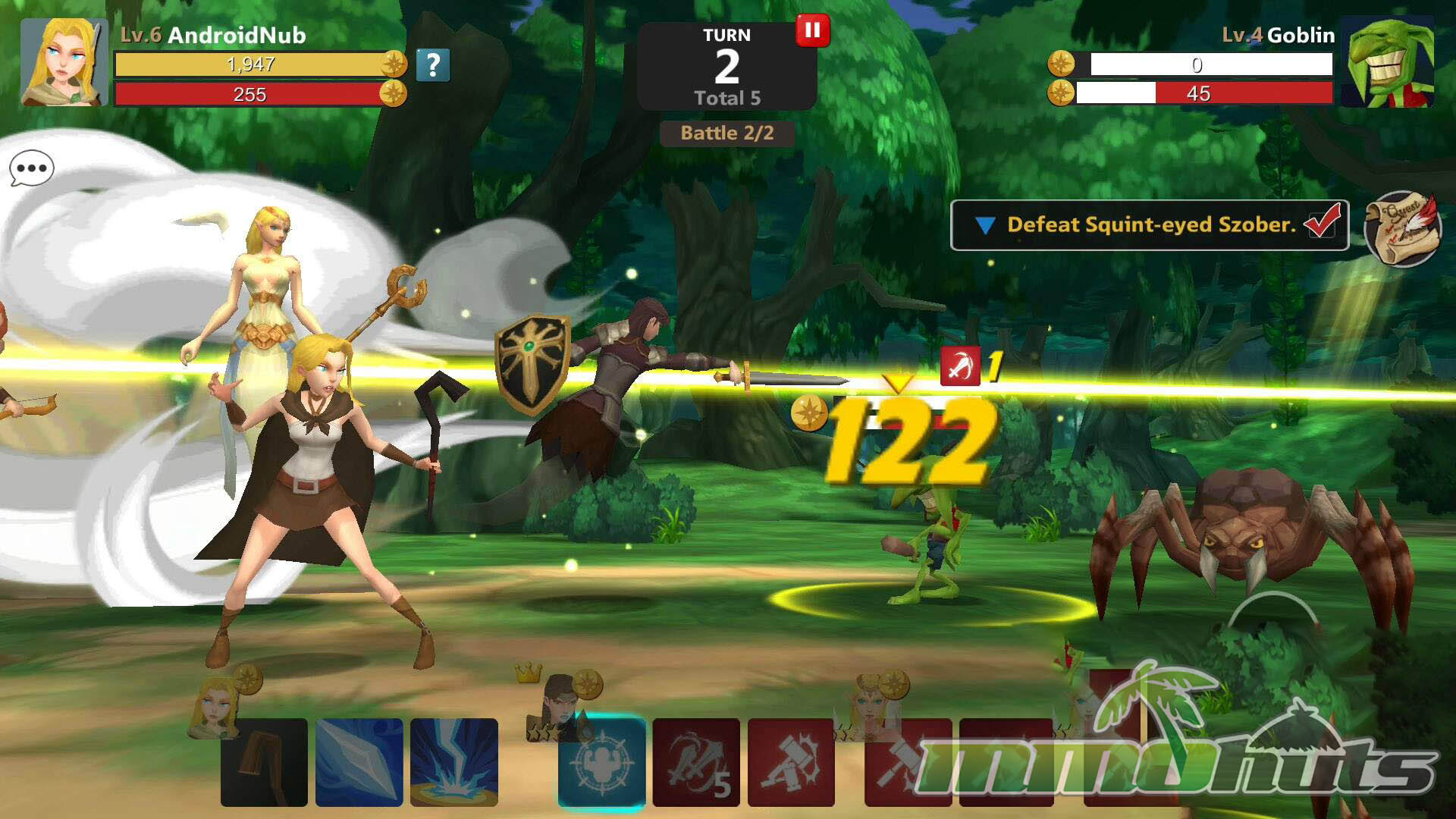
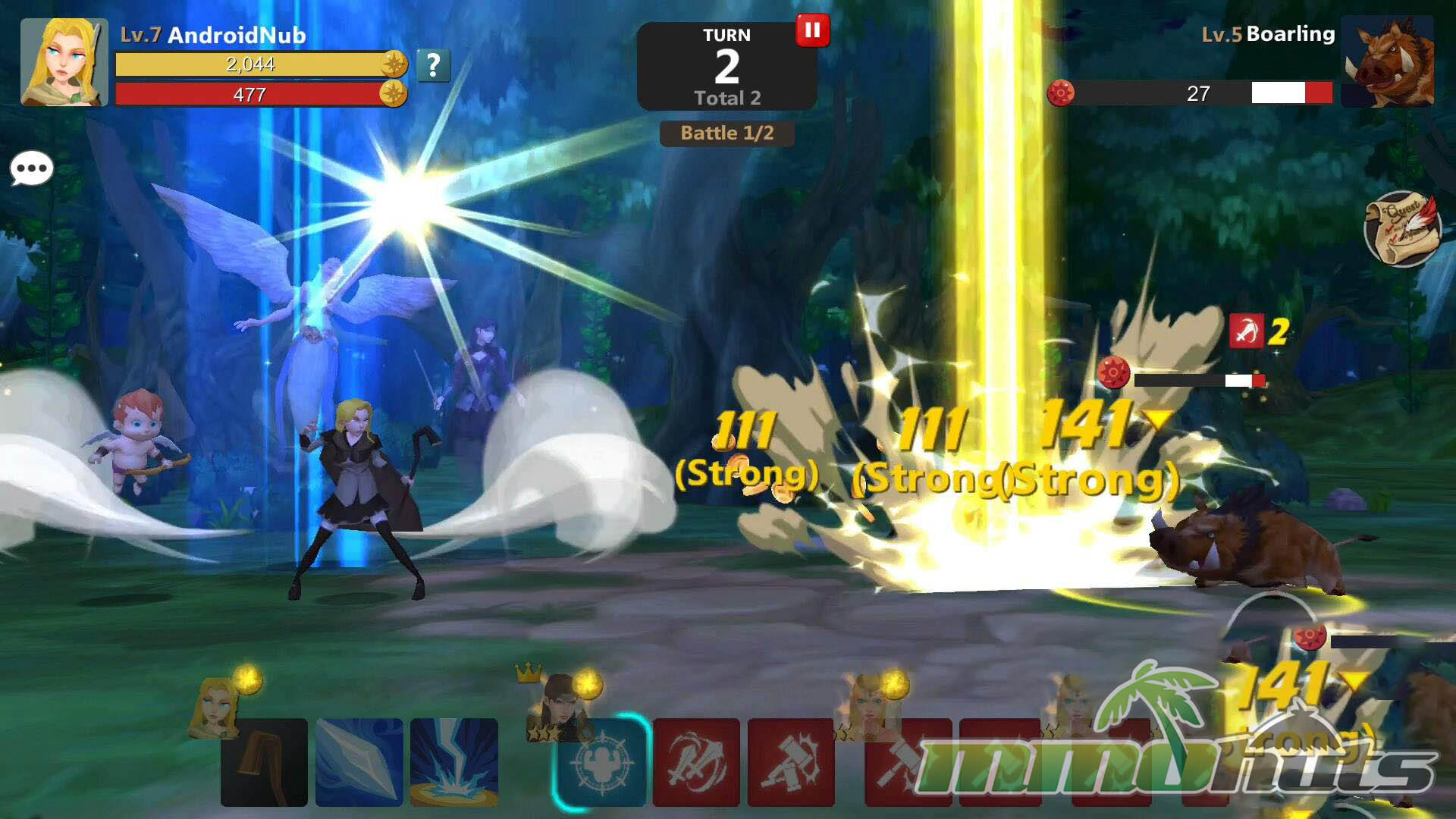
- 3D Fantasy Graphics – Bright, stylized 3D models and effects give the Guardians, enemies, and environments a lively fantasy look.
- Turn-based Combat – A straightforward interface hides a tactical layer, with skills, cooldowns, elemental advantages, and turn-based bonuses shaping optimal play.
- Many Guardians to Collect – Recruit over 69 Guardians, develop them with levels and Runes, then evolve them to higher tiers for stronger builds.
- Asynchronous PVP – Fight other players’ teams in AI-controlled defense battles and climb through league rankings.
- Additional PVE Modes – Run repeatable dungeons for materials like Runes, Essences, Rubies, and other progression resources.
Guardian Stone Screenshots





Guardian Stone Featured Video

Guardian Stone Review
Guardian Stone arrived during the boom of mobile, roster-based RPGs, and it clearly shares DNA with the genre’s staples. You assemble a party, chase higher-tier pulls, and grind repeatable content for better gear and materials. What helps it feel a bit distinct is its side-scrolling stage structure and a combat system that, while easy to operate, rewards careful sequencing of cooldowns and turn-based bonuses. It is not a particularly story-driven or visually experimental game, but it can be surprisingly engaging when you start optimizing teams and pushing into harder stages.
Choosing Your Class and Getting Started
At the beginning, you pick a main class and a starter Guardian. The three classes are Warrior, Ranger, and Sorceress, each defined mostly by their combat tools. Warriors lean into sturdiness through higher barrier and health plus aggressive melee-leaning skills. Rangers focus on speed and critical hits with strong single-target pressure. Sorceresses emphasize area damage and elemental magic for clearing groups efficiently. As you level up, you unlock more skills, but only two can be equipped for battles at any time, so your build is more about selecting the right tools than simply stacking everything.
Outside of combat, your hero’s power is heavily tied to equipment. Gear can be upgraded by consuming other items, and it can also be refined with Gems for additional gains. Class choice changes how fights feel and what kinds of Guardians pair well with your kit, but it does not meaningfully alter the narrative or offer appearance customization.
A Stage-Based Adventure with Hub Progression
Like many mobile RPGs, the game is organized around a central town hub and a chain of instanced stages. In town you manage your roster, sort inventory, upgrade and forge, and accept quests that frame the next set of battles. Stages themselves are compact and repeatable, typically structured around multiple waves and a steady ramp in difficulty as you advance through a map.
A boss appears regularly (every five stages), and those boss fights serve as both progression markers and reliable sources of equipment. There is also a star rating for each stage based on turn efficiency, encouraging you to refine your team and skill timing rather than simply surviving. Earning three stars across a full map (10 stages) pays out a Guardian shard reward, creating a long-term incentive to revisit content and perfect clears even if the baseline gold and experience rewards remain similar.
Turn-Based Battles Built Around Skill Timing
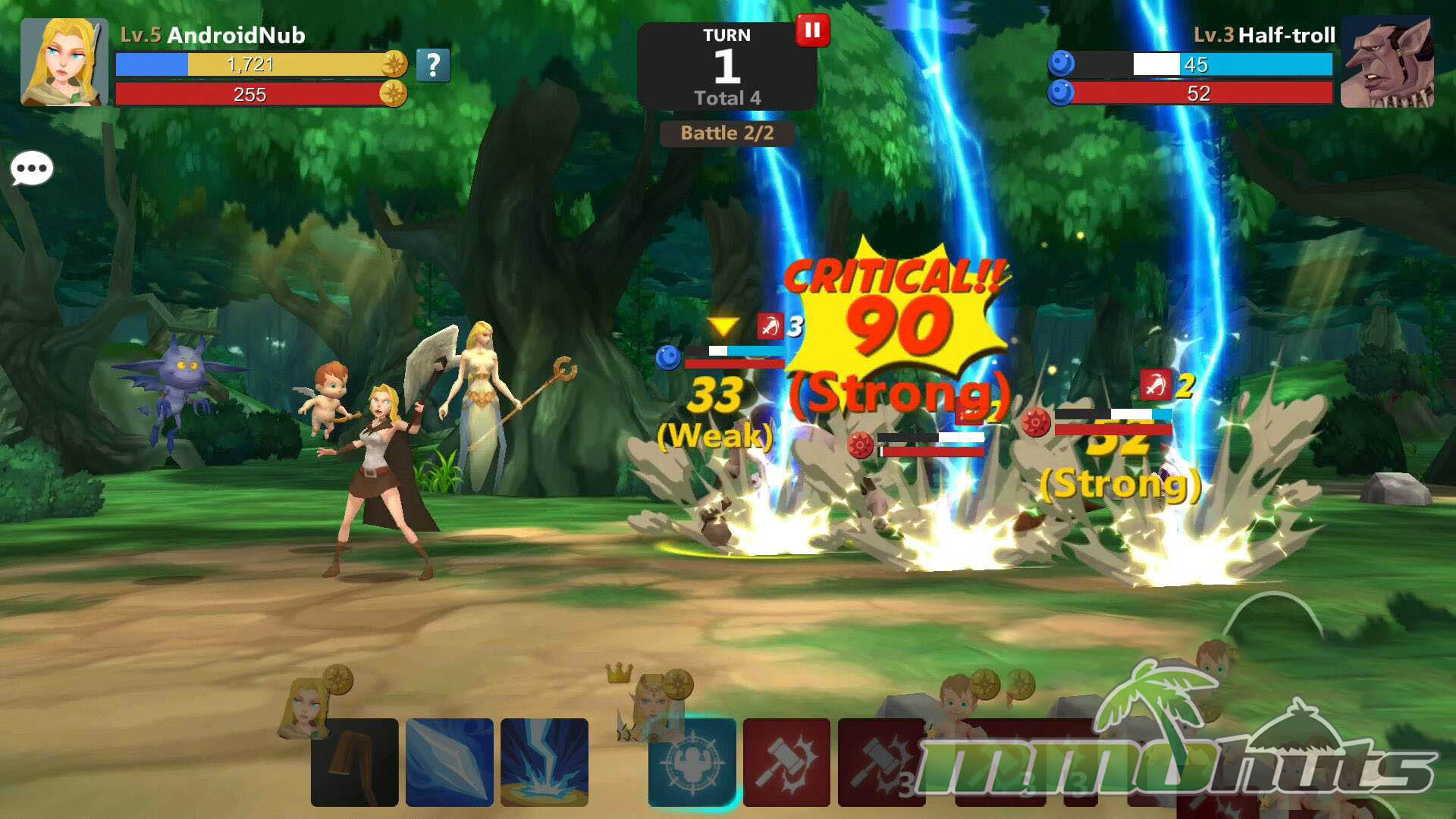
Combat is the core of Guardian Stone, and it is more deliberate than it first appears. You bring three Guardians into battle alongside your hero, and you directly control everyone’s skill use. Guardians are unusual in that they do not perform basic attacks, they are essentially bundles of abilities with cooldowns. Both your hero and each Guardian have two active skills, and the key decision each turn is which ability to spend and which cooldowns to hold for the next wave or the next turn window.
An important twist is that Guardians do not rotate through a strict “each unit takes a turn” order the way some turn-based games do. You can use Guardian skills in flexible sequences, but the long cooldowns prevent mindless spamming. This structure makes party composition matter, since you want coverage across single-target bursts, AoE clears, buffs, debuffs, and healing depending on the stage. Many skills also include conditional bonuses, for example extra damage on odd or even turns, or improved effects when attacking a target without barrier, which nudges you toward planning rather than reacting.
Two additional systems shape the flow of fights. First is the barrier mechanic, which functions like a protective layer that must be broken before health can be damaged. Because enemies primarily target your hero (Guardians cannot be attacked and do not have health), barrier becomes the main line of defense and the central resource to manage. Second is the elemental advantage loop (Stellar > Solar > Lunar > Stellar), which provides the expected damage bonuses and penalties when you attack into favorable or unfavorable matchups.
There is also an Auto option (unlocked at level 10), but it tends to waste turns and mismanage cooldowns, which can be actively harmful in tougher content. Manual play is where the game’s tactics actually show, even if the overall encounter format can feel repetitive across long sessions.
Collecting, Building, and Evolving Guardians
The roster is one of Guardian Stone’s main selling points, with over 69 Guardians spanning different elements, roles, and tiers. Some are clearly designed for support, offering healing or party buffs, while many focus on damage either as single-target finishers or wave-clearing AoE options. Each Guardian also carries a Leader skill that only applies when placed in the leader slot, granting bonuses such as increased barrier or improved attack power, which adds another layer to team planning.
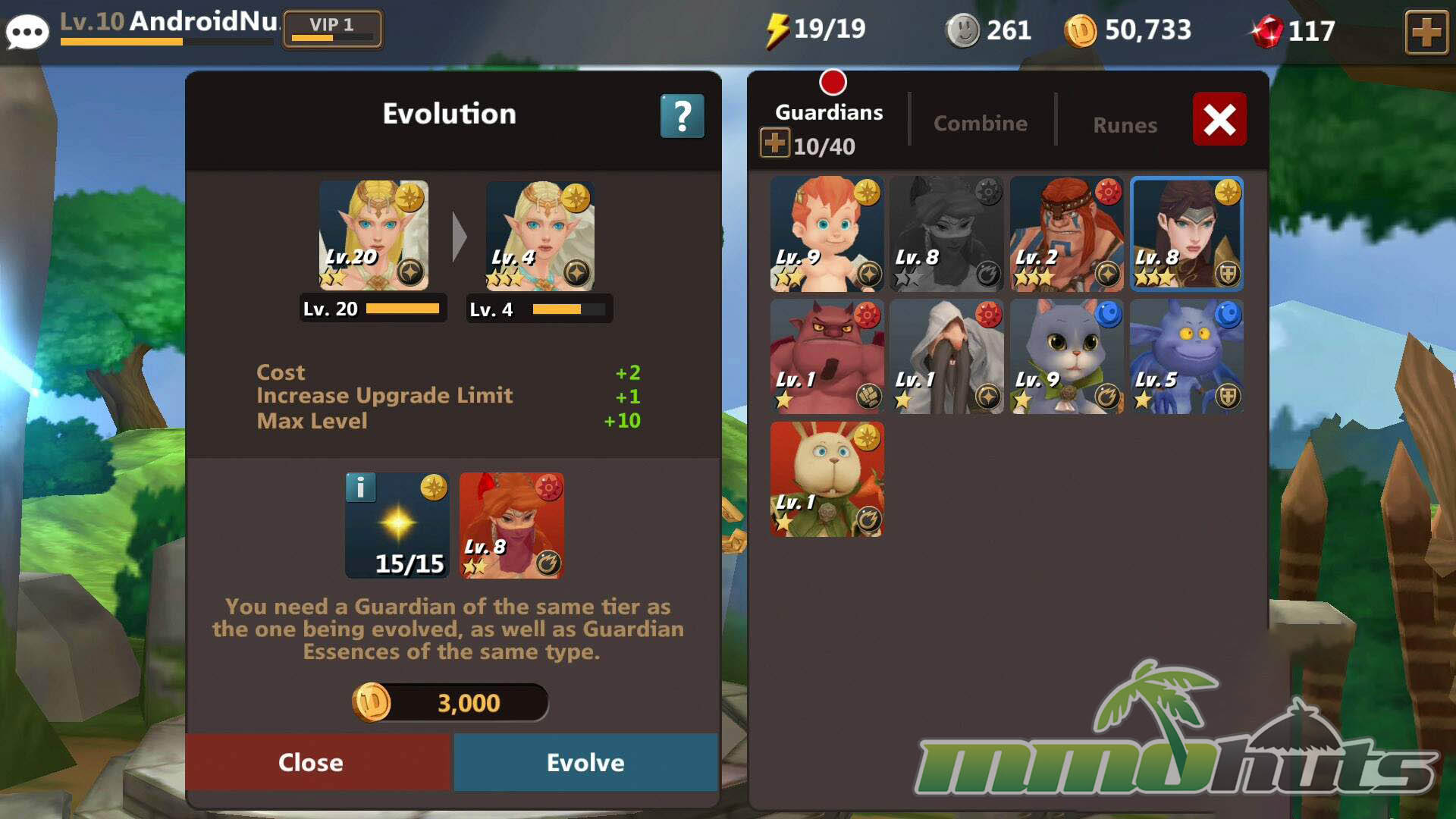
Guardians range from 1 to 6 stars (tiers). You can obtain them by gathering enough shards for a specific summon or by using Special Summons (gacha). Advancement is tied to leveling and evolution. To evolve, you need elemental Essences (with higher-tier Guardians requiring more) and you must sacrifice a Guardian of the same tier. Pushing a unit all the way to Tier 6 is therefore a long-term project that often turns into repeated dungeon runs to stockpile Essences and the right sacrifice materials.
Runes further customize performance. Equipping Runes grants stat bonuses, and matching three Runes of the same shape unlocks additional set effects, which encourages targeted farming and incremental optimization.
Asynchronous PvP in a League Ladder
PvP is presented as tavern battles, and it is asynchronous in the sense that you fight AI-controlled defenses rather than live opponents. Still, you are not forced into automated play, you retain full control of your turns, which keeps the mode from feeling like a passive numbers check. Because only the player character can be attacked, PvP plays differently than PvE mob fights, and it naturally pushes you toward barrier-breaking and focused damage rather than relying purely on AoE.
The ranking structure is divided into Leagues (Bronze, Silver, Gold, Masters, Champions), each split into three sub-ranks (for example Bronze III to Bronze I). Players are grouped with a set of opponents, and performance over the time window determines who advances. It borrows the general feel of league ladders seen in competitive games, and while balance depends heavily on roster strength and rune quality, it offers a consistent change of pace from stage farming.
Extra PvE Modes for Materials and Variety
Beyond the story stages, Guardian Stone includes several repeatable PvE activities meant to feed your upgrade loop. Rune Dungeons exist for each element and use the same energy resource as the main stages. Each Rune Dungeon has four difficulties, with higher tiers consuming more Energy but offering better drops. Essence Dungeons focus on the Essences required for evolution, making them a key stop once you begin pushing toward higher-tier Guardians.
There is also a Treasure Hunt mode structured as 10-stage maps with special rewards per stage, including gold, Essences, and Rubies. For players who want a more “how far can you go” challenge, Challenge Mode functions like a boss progression ladder. You fight large Champion Guardians in 1 vs 1 battles, and each victory causes the boss to return at a higher level until you eventually lose. Periodic limited-time activities, such as Goblin Hunt, add timed objectives and give additional reasons to log in and spend energy.
Cash Shop and Premium Currency
Monetization follows the familiar mobile RPG template. Rubies, the premium currency, can be spent on summoning Guardians and Runes (3 to 6 stars), refilling energy, and purchasing gold plus temporary boosters for gold and experience. A VIP system also exists, tied to Ruby purchases, and grants escalating conveniences such as more energy refills per day and additional special dungeon attempts.
In practical terms, spending accelerates progress by reducing the time needed to assemble higher-tier teams and rune sets. It is possible to build a full 6-star lineup without paying, but the grind increases as difficulty ramps up, especially when you are farming Essences, chasing rune upgrades, and optimizing leader skills. PvP can feel pay-leaning in the short term because stronger runes and higher-tier Guardians arrive faster with purchases, although persistent free players can close the gap over time. The game also provides Rubies through events, achievements, and login rewards, which helps keep the shop from feeling mandatory for basic progression.
Final Verdict: Good
Guardian Stone is a solid entry in the mobile, hero-collecting RPG space, with a combat system that rewards timing and planning more than its simple presentation suggests. Its biggest drawback is how quickly the loop can become repetitive once you settle into farming for Essences and rune upgrades. For players who enjoy building teams, managing cooldowns, and steadily perfecting stage clears, the mix of Guardian collection, league-based PvP, and multiple PvE modes makes it a worthwhile casual strategy RPG.
Guardian Stone Links
Guardian Stone Official Site
Guardian Stone Google Play
Guardian Stone iOS
Guardian Stone Official Facebook
Guardian Stone Requirements
Minimum Requirements:
Android 2.3 and up / iOS 5.1.1 or later
Guardian Stone Music & Soundtrack
Guardian Stone Additional Information
Developer: TOAST
Publisher: NHN Entertainment
Platforms: Android, iOS
Release Date: January 20, 2016
Shut Down Date: September, 2016
Guardian Stone was developed by TOAST and published by NHN Entertainment, the team behind Guardian Hunter and Crusaders Quest. Guardian Stone had a 1-week closed beta test on February 2015 and then entered soft launch testing on July 29, 2016 in 9 countries before it finally launched worldwide on January 20, 2016 known as Guardian Stone: Second War. After shutting down PC games such as ASTA, Devilian, and Echo of Soul, NHN Entertainment has been focusing its attention on mobile with many more games set to launch in 2016, one of which was Guardian Stone. NHN Entertainment is also the publisher of the popular mobile games, Battle for the Throne, Kill Me Again: Infectors, and Drift Girls.
Guardian Stone shut down in late 2018 after failing to attract a large enough audience to keep the game viable.