Wuthering Waves is a free-to-play, cross-platform open world action RPG with a post-apocalyptic anime style and a heavy emphasis on fast, technical combat. You play as Rover, an amnesiac traveler exploring the world of Solaris-3 alongside a growing roster of allies called Resonators, while collecting monster-based abilities through the unique Echo system.
 | Publisher: Kuro Games Playerbase: High Type: Mobile / PC / Console RPG Release Date: May 22, 2024 (Global) Steam Release Date: April 29, 2025 Pros: +Sharp, skill-based combat with parries, dodges, and swap-cancel windows. +Echo system gives gear progression a fun monster-collecting twist. +Generous traversal with wall running, gliding, and a grappling hook. +Strong production value with memorable music. Cons: -Standard gacha pulls for the strongest 5-star Resonators and weapons. -PC build is more demanding than rival anime RPGs. -Launch period was rough and some old reputation still lingers. |

Wuthering Waves Overview
After a global catastrophe known as the Lament, the planet Solaris-3 was left scarred and overrun by strange creatures called Tacet Discords. Humanity slowly clawed its way back into the world, and you wake up as the Rover, an amnesiac with strange resonance abilities and a knack for picking up the powers of the things you fight. From there the game spreads outward into a sci-fi fantasy open world stitched together from huge regions, story arcs, and a steadily growing list of playable characters.
People will compare it to Genshin Impact almost on instinct, and there is some truth to that comparison, but Wuthering Waves leans much harder into action combat. There is no auto-play, fights expect you to actually parry and dodge, and the traversal layer is built around speed rather than gentle exploration. It is a gacha game, no way around that, but it is also one of the more mechanically demanding entries in the genre.
Wuthering Waves Key Features:
- Story-Driven Open World – A long main quest that takes you across Huanglong, Rinascita, and beyond, with regular cinematic story chapters and fully voiced cutscenes.
- Echo System – Defeat enemies in the wild and absorb their phantoms as Echoes, which act as both equipment and active skills you can chain into your combos.
- Resonators and Roles – Collect 4-star and 5-star Resonators that fill main DPS, sub DPS, and support roles, and build three-character teams that play off each other through swap mechanics.
- Action-First Combat – Snappy, real-time fights with parries, perfect dodges, intro and outro skills on character swap, and bosses that punish careless play.
- Free Movement – No stamina bar on traversal, so you can wall run, glide, swim, and use a grappling hook or motorbike to fly across the map without worrying about a meter.
Wuthering Waves Screenshots


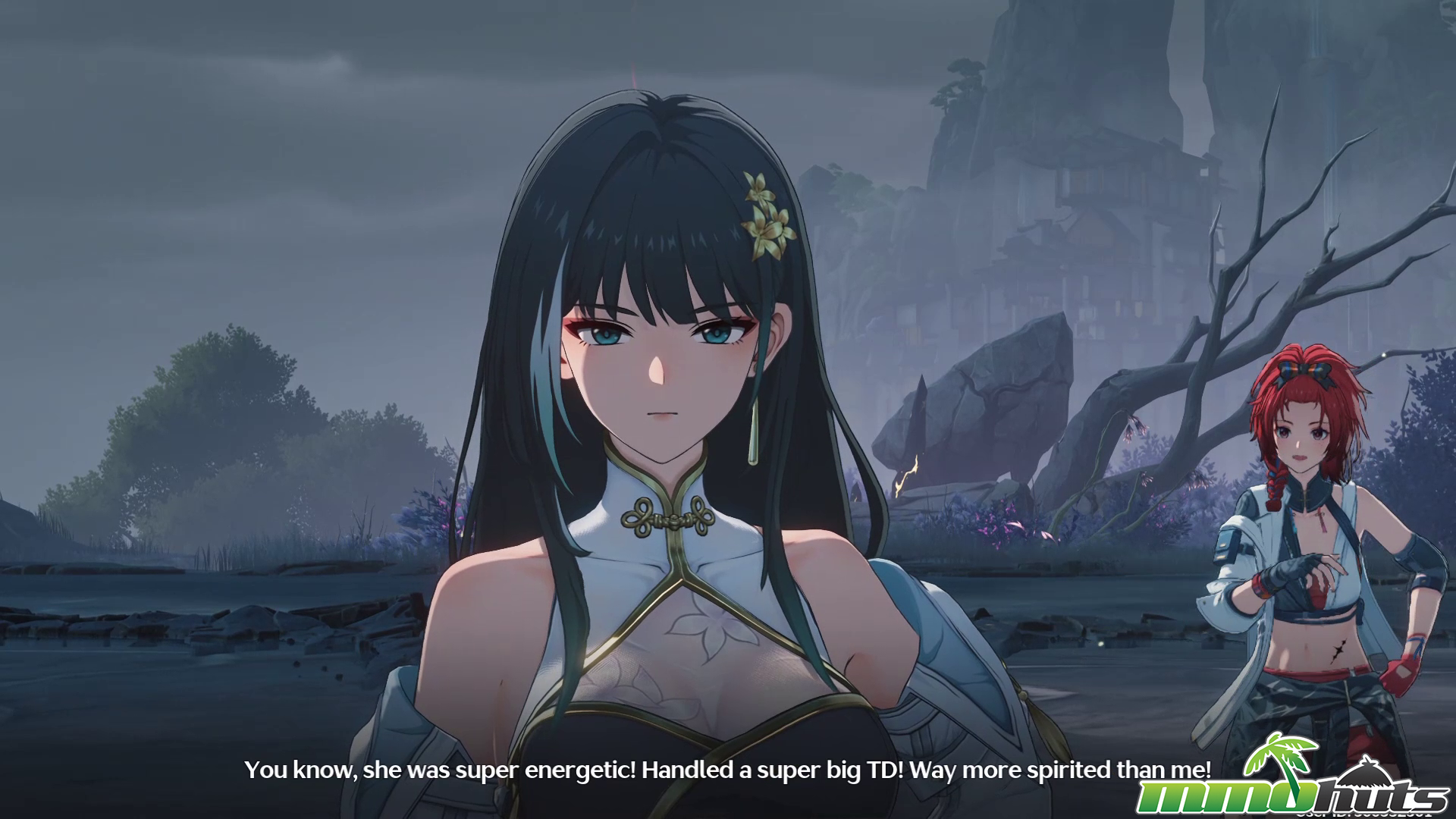


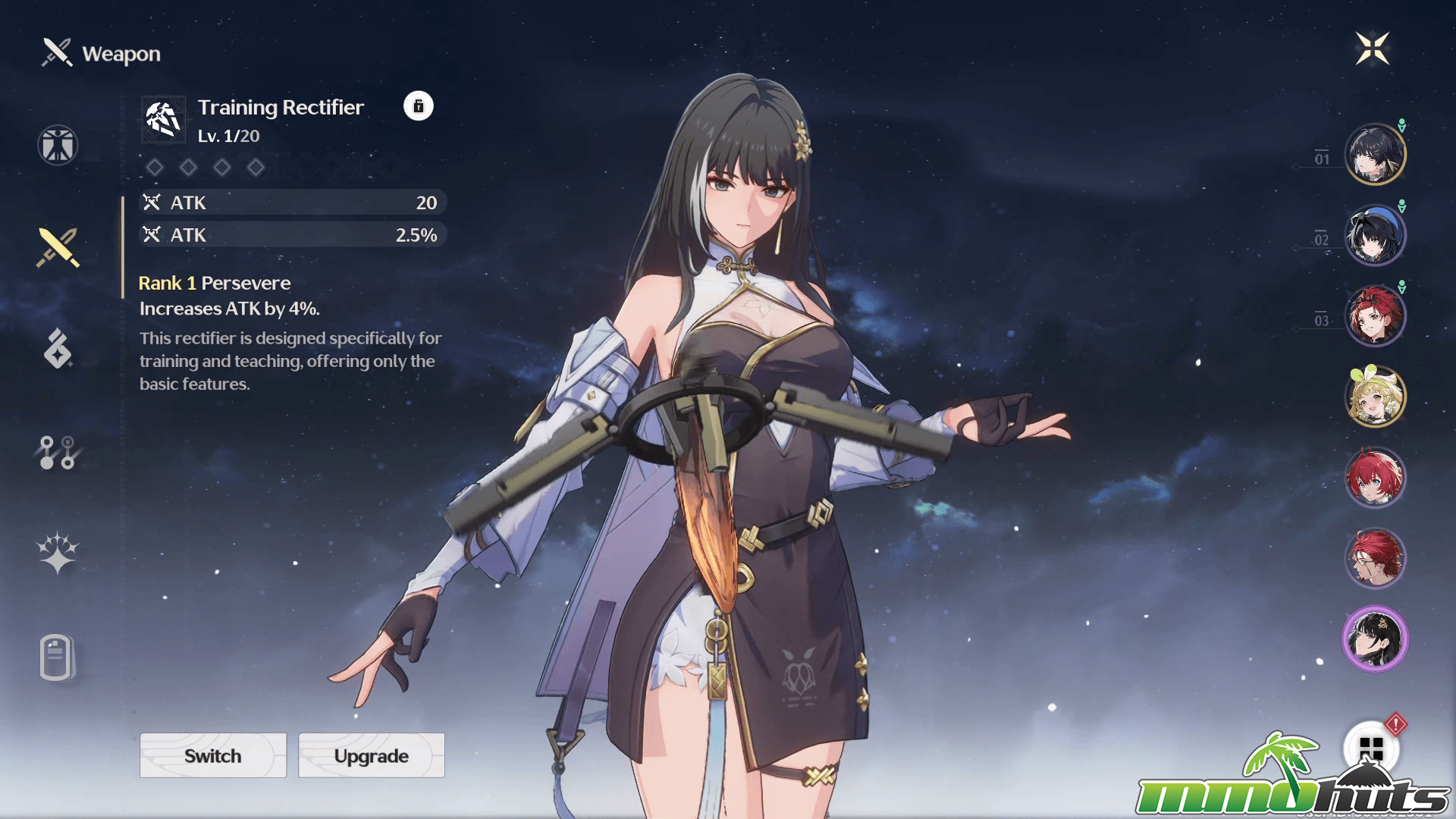

Wuthering Waves Featured Video

Wuthering Waves Review
Wuthering Waves is a free-to-play open world action RPG developed and published by Kuro Games, the same studio behind Punishing: Gray Raven. It launched globally on May 22, 2024 (May 23 in most regions outside the US) on PC and mobile, and has steadily grown its platform list since, picking up a PS5 version in early 2025, a Mac client a few months later, and a proper Steam release in April 2025. An Xbox Series X/S port is also lined up. The point being, by now it is easy to find a way into the game on whatever device you actually use.
First Impressions and Setting
The opening hours throw a lot at you. Wuthering Waves wants you to know its world is in trouble. Solaris-3 is a planet rebuilding after the Lament, a catastrophe that wiped out most of humanity and left the survivors fighting back against Tacet Discords, the monsters that spilled out from the disaster. You are the Rover, an amnesiac with abilities that let you “resonate” with the world, which conveniently doubles as a reason for the game to introduce mechanics one by one as your character “remembers” them.
The first major hub, Huanglong, is heavily inspired by classical Chinese architecture, while later regions like Rinascita lean toward a Mediterranean aesthetic with floating islands and city-states. The art direction is consistently strong, even if performance on lower-end hardware can take a hit. The soundtrack, composed by Hoyo-Mix collaborator Vanguard Sound, is genuinely one of the strongest parts of the package. The vocal tracks for major story moments hit harder than they really need to.
It is worth flagging up front that the launch was bumpy. There were animation glitches, audio bugs, an awkward Epic Games launcher fatal error problem, and some early story content that even Kuro themselves admitted needed reworking. A lot of that has been smoothed out across the past year and a half of patches, and the studio has been pretty active about pushing fixes and compensation, but if you bounced off the game in mid-2024, you are coming back to a noticeably more polished product.
Combat and the Swap Loop
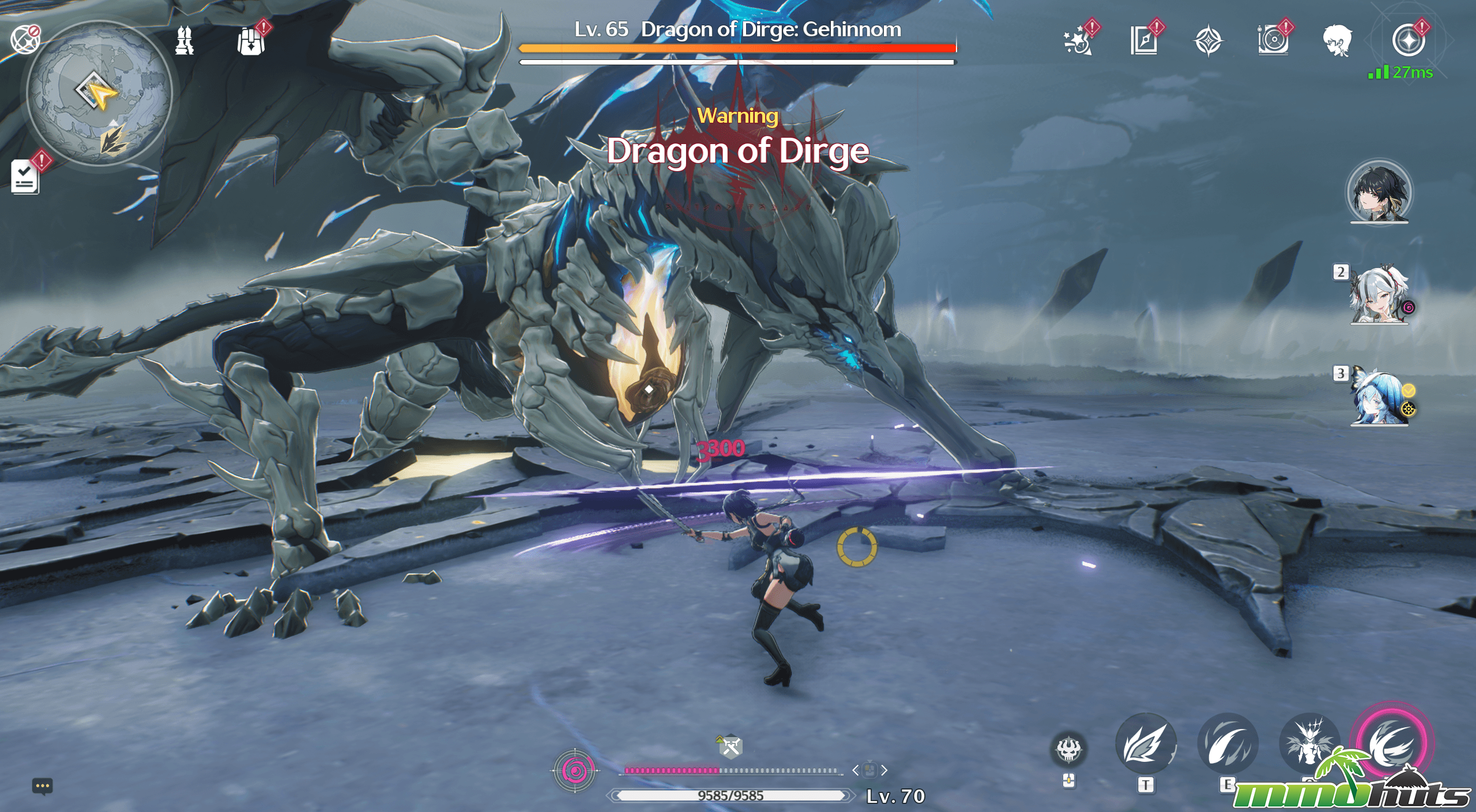
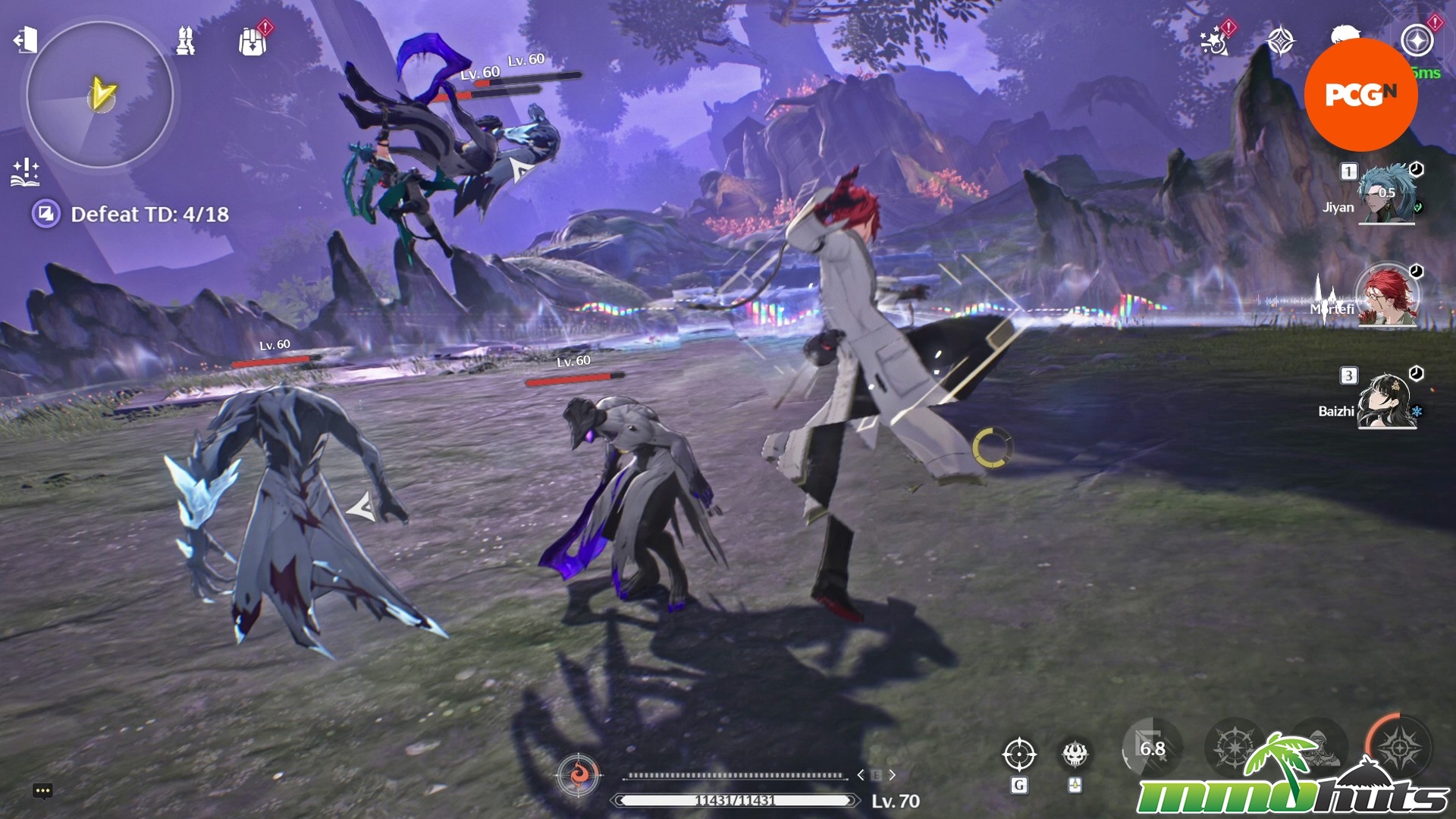
Combat is where Wuthering Waves earns most of its goodwill. You bring a team of three Resonators into a fight and swap between them constantly. Each character has a basic attack string, a Resonance Skill (a short cooldown ability), a Resonance Liberation (their ultimate), an Intro Skill that fires when you swap into them, and an Outro Skill that triggers when you swap out at the right moment. Stitch those together correctly and a fight becomes a chain of high-damage swaps that always keep at least one character on screen attacking.
The signature trick is the swap-cancel. If you time a swap during the right animation window, the next character will burst onto the field with their Intro Skill, often interrupting an enemy and creating openings for the rest of the team. Once it clicks, regular trash mobs go down in seconds and even tougher world bosses start to feel manageable. New players will struggle here, that part is real, the tutorialization on these advanced mechanics is not great. You learn most of it from creators and trial and error.
Defense matters more than in many gacha competitors. Perfect dodges open up Extreme Evasion windows that briefly slow time, and well-timed parries punish heavy attacks before they connect. The Holograms, which are time-limited solo boss fights with elemental restrictions, are basically the game’s challenge mode, and they expect you to actually learn patterns and play around them. It is the closest a gacha RPG comes to a proper action game on this scale.
The Echo System
Echoes are Wuthering Waves’ answer to artifacts in similar games, but with more personality. Defeat a Tacet Discord (a monster) in the open world and there is a chance to absorb its Echo, which slots into one of your Resonator’s five Echo slots. The first Echo equipped also gets an active ability tied to the monster you absorbed, so the very same boss you just killed can become a summon you toss out mid-combo, or a transformation that briefly turns your character into the creature.
It scratches a Pokemon-style itch in a way that artifacts in other gacha games never quite manage. You actually want to go fight specific monsters because their Echo abilities matter, not just because of stat rolls. The flip side is that Echo grinding is still RNG farming at heart. Sub-stats roll randomly, sets matter, and the difference between a “decent” Echo and a “godroll” Echo on a single piece can be massive. Endgame players spend a lot of time on this.
Gacha and Progression
Now for the part everyone wants to know about. Wuthering Waves uses a gacha system called Convene. Standard banners pull from the wider character roster while limited Featured banners run alongside each version, usually featuring a new 5-star Resonator and their signature weapon. The pity system is fairly clean: 80 pulls guarantee a 5-star, the rate-up character is a 50/50, and losing the 50/50 once means the next 5-star is guaranteed to be the rate-up. Limited weapon banners have their own track and are notably more reasonable than some competitors.
The free-to-play income is where Kuro has built up a reputation. Lustrous Tides and Astrites flow in pretty steadily from exploration, weekly bosses, the Tower of Adversity, login events, and version events. It is not infinite, of course, but a patient F2P player can comfortably plan around landing one or two big pulls per patch cycle. Compared to similar gacha titles, the income often feels more generous, though that calculus shifts as the roster grows and you start chasing constellations (or, in this game, Resonance Chains).
The downside is the same as any gacha. The very strongest team comps almost always involve specific 5-stars and their signature weapons, and certain characters dramatically outperform others as new content scales up. You can absolutely clear story content and most endgame with 4-stars, but speedrunning the leaderboards or maxing your Tower of Adversity scores will eventually push you toward chasing the meta. None of this is unusual for the genre, but it is worth being honest about.
Exploration and World Design
The traversal layer is one of the most underrated parts of the game. Movement has no stamina cost. You can sprint, wall run, swim, and glide forever, and once you unlock the grappling hook and the motorbike, getting from waypoint A to waypoint B becomes its own little game. The team clearly studied modern open world design, including some Death Stranding influence on the early conceptual stages, and the result is a world that respects your time when you are just trying to get somewhere.
Side content is the usual mix of puzzles, hidden chests, exploration challenges, and world quests. Some of these are genuinely well written and self-contained, others are clearly just there to feed Astrite payouts and Union Level. The map fills up fast as new versions add new regions, and unlike some of its peers, Wuthering Waves does not gate huge swaths of content behind your story progress in a punishing way. You can wander.
Co-op and Shared World Stuff
Wuthering Waves does have multiplayer, but it is a more casual layer than what something like Tower of Fantasy offers. Once you hit Union Level 22 you can party up with up to two other players and explore the open world together, take down Tacet Discords for Echoes, and tackle certain bosses as a group. There is no full PvP suite, no large-scale arena, and the world is not a persistent shared space the way an MMO is. It is closer to Genshin’s co-op in scope, with the host doing most of the heavy lifting and guests joining in for combat assists.
For most players this is fine, the game is built around the single-player journey, and grouping up to grind a few Holograms or world bosses with friends covers the social itch. But if you came in expecting a real MMO, that is not what is on offer here.
Wuthering Waves vs Genshin Impact
You cannot really avoid this comparison and Kuro probably knew that going in. Both games sit in the same general space: anime-styled open world gacha RPG with elemental combat. Where they diverge is in priorities. Genshin leans further into puzzle exploration, story polish, and a slower combat loop built around elemental reactions. Wuthering Waves leans into action, mobility, and a higher mechanical skill ceiling.
If you came to gacha RPGs because you wanted Devil May Cry-lite combat with character collecting on top, Wuthering Waves is the easier recommendation. If you wanted a softer, more exploratory adventure where the puzzles and the world itself are the main attraction, Genshin still has the edge in cohesion and overall finish. Honestly there is no reason a person has to pick one, the income loops in both games are designed to slot into a daily routine, and a lot of players just rotate through them.
Final Verdict – Great
Wuthering Waves is one of the better gacha-driven open world RPGs you can play right now, especially if combat is the part of the genre you actually care about. The swap-cancel system, the Echo skills, and the high mobility traversal make moment-to-moment play feel snappier than most of its competition, and the soundtrack and presentation back up that combat with real production value. It has its share of issues. The launch was rocky, the gacha still wants your money, and the early story struggles to hit the same beats as the late-game arcs. But Kuro has been steady about updates and the game is in a noticeably better place now than it was at launch. If you are looking for a free-to-play action RPG with real teeth and you do not mind the gacha layer, this is an easy pick.
Wuthering Waves Links
Wuthering Waves Official Site
Wuthering Waves Google Play
Wuthering Waves App Store
Wuthering Waves Steam Page
Wuthering Waves Epic Games Store
Wuthering Waves Twitter
Wuthering Waves Facebook
Wuthering Waves Reddit
Wuthering Waves Discord
Wuthering Waves YouTube
Wuthering Waves System Requirements
PC Minimum Requirements:
Operating System: Windows 10 64-bit
CPU: Intel Core i5 (9th Gen) / AMD Ryzen 2700
Video Card: Nvidia GeForce GTX 1060 / AMD Radeon RX 570
RAM: 16 GB
Hard Disk: 30 GB (HDD supported, SSD recommended)
PC Recommended Requirements:
Operating System: Windows 10 / 11 64-bit
CPU: Intel Core i7 (9th Gen) / AMD Ryzen 3700 or better
Video Card: Nvidia GeForce RTX 2060 / AMD Radeon RX 5700 XT or better
RAM: 16 GB
Hard Disk: 30 GB SSD required
Android Minimum Requirements:
OS: Android 7.0 or above
CPU: Snapdragon 835 / MediaTek Dimensity G71 or G72 (or equivalent)
RAM: 4 GB
Storage: 10 GB
Android Recommended Requirements:
Operating System: Android 11 or above
CPU: Snapdragon 8 Gen 1 / Gen 2 / Gen 3, or comparable MediaTek Dimensity 9000 series
RAM: 8 GB or more
Storage: 15 GB
iOS Requirements:
Operating System: iOS 14 or above
Storage: 12 GB
Supported Devices: iPhone 11 and newer (iPhone 13 or newer recommended)
Wuthering Waves Music & Soundtrack
Coming soon!
Wuthering Waves Additional Information
Developer: Kuro Games (Guangzhou Kuro Technology Co., Ltd.)
Publisher: Kuro Games
Engine: Unreal Engine 4
Director: Solon Lee
Global Release Date: May 22, 2024 (PT) / May 23, 2024 (most regions)
PlayStation 5 Release Date: January 2, 2025
macOS Release Date: March 27, 2025
Steam Release Date: April 29, 2025
Apple Vision Pro Release Date: July 3, 2025
Xbox Series X/S Release Date: July 2026 (announced)
Platforms: Microsoft Windows, Android, iOS, macOS, PlayStation 5, Steam, Epic Games Store, Apple Vision Pro, Xbox Series X/S
Development History / Background:
Wuthering Waves is the second major title from Chinese developer Kuro Games, following their action mobile game Punishing: Gray Raven. The project was first revealed in May 2022 with cinematic teasers and went through two closed beta tests before its global launch. Initial inspirations included Death Stranding, with Kuro citing the goal of building a post-apocalyptic world that fused old and new civilizations, while the combat pulled directly from Punishing: Gray Raven and the Echo system drew from the Pokemon games. After a feedback-heavy first beta, the studio reworked significant portions of the early story before launch. The global release on May 22, 2024 had a famously rocky start with bug reports and performance issues, but Kuro pushed through with consistent patches and goodwill compensation, and the game has since grown into one of the most successful new entries in the gacha RPG space. In a September 2025 statement at Gamescom, Tencent identified Wuthering Waves as one of just six new titles from the previous year to clear its internal “evergreen” revenue benchmark, alongside games like Black Myth: Wukong and Helldivers 2.