
Golden Rush
Golden Rush is a quirky take on the MOBA formula from the same circle behind My Lands: Black Gem Hunting. Instead of a standard lane-pushing match, it throws four teams into one arena where the win condition is pure accumulation, either reaching 30,000 gold or securing twelve chests before everyone else.

|
Publisher: Elyland Investment Co Playerbase: Low Type: MOBA Release Date: September 23, 2015 Shut Down Date: September 27, 2018 Pros: +Attractive presentation. +Clean UI that is easy to read. +Distinct structure compared to most MOBAs. Cons: -Heavy reliance on gear grinding. -Permanent hero leveling creates uneven matches. -Paid skins provide stat boosts. -Unlocking extra classes takes far too long without paying. -Very small population leads to long queues in some modes. -Noticeable pay-to-win pressure. |
Golden Rush Overview
Golden Rush is an “unusual” MOBA from the creators of My Lands: Black Gem Hunting, Forbes Consult and Elyland Investment Company. The big twist is the match format, four teams of three compete on a single battleground and the objective is not to destroy a base, but to out-earn everyone else. Depending on the mode, victory comes from hitting 30,000 gold first or by collecting twelve chests before rival squads can do the same.
All action happens on one arena, the “Garden of Heroes.” Teams start from separate corners and rotate through capture points and monster camps while trying to deny the same resources to opponents. Two roaming objectives spice up the routine, the Golden Frog can be hunted for bursts of rewards, and the Golden Dragon is a major fight that can swing momentum by granting a powerful helper. As you continue playing, your heroes (called classes here) gain levels over time and can be outfitted with increasingly strong gear. Completing a full “artifact” set even unlocks a valuable fourth skill, pushing the game closer to MMO-style progression than a traditional match-only MOBA.
Golden Rush Key Features:
- A different kind of MOBA – Matches run as four 3-player squads, with the focus placed on farming camps and collecting resources instead of sieging structures.
- Two modes – Win by reaching 30,000 gold first or by securing twelve chests, depending on the selected mode.
- Earn a powerful ally – Taking down the Golden Dragon rewards your team with a Bone Dragon ally that can help hold a tower.
- Six classes – Choose from six distinct classes, with three available to players for free.
- Persistent progression – Level up each class and acquire gear over time via a persistent system that resembles MMORPG character growth.
Golden Rush Screenshots





Golden Rush Featured Video

Golden Rush Review
Golden Rush comes from Russian developer Forbes Consult and publisher Elyland Investment Company, with clear connective tissue to My Lands: Black Gem Hunting. The most obvious link is currency, Black Gems show up here as well, and the overall progression mindset feels closer to a browser MMO than a modern competitive MOBA. Its standout hook is match structure, four teams of three share the same map, turning fights into chaotic skirmishes and opportunistic third-party engagements rather than the familiar two-side push-and-pull.
Basic Gameplay
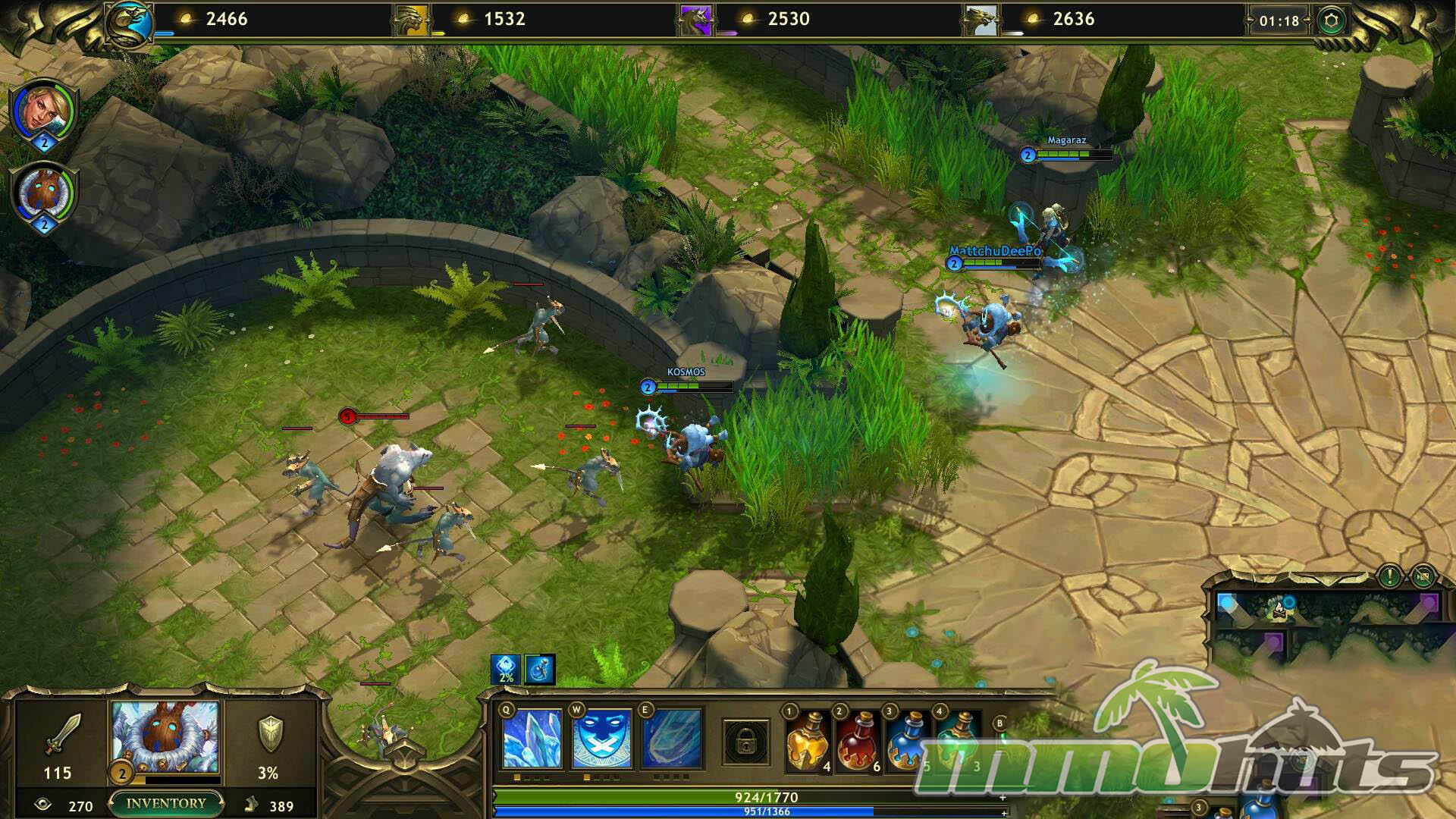
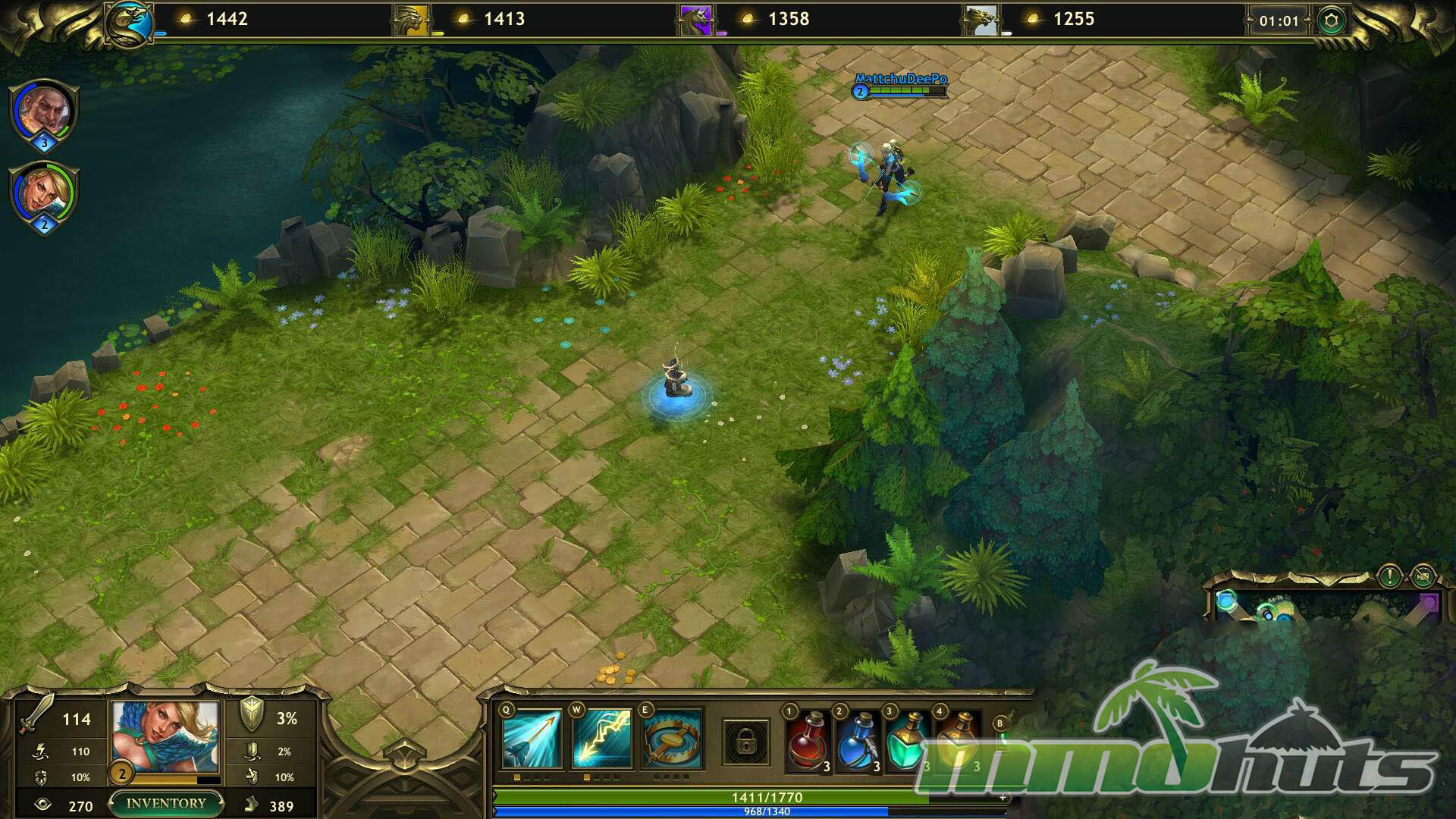
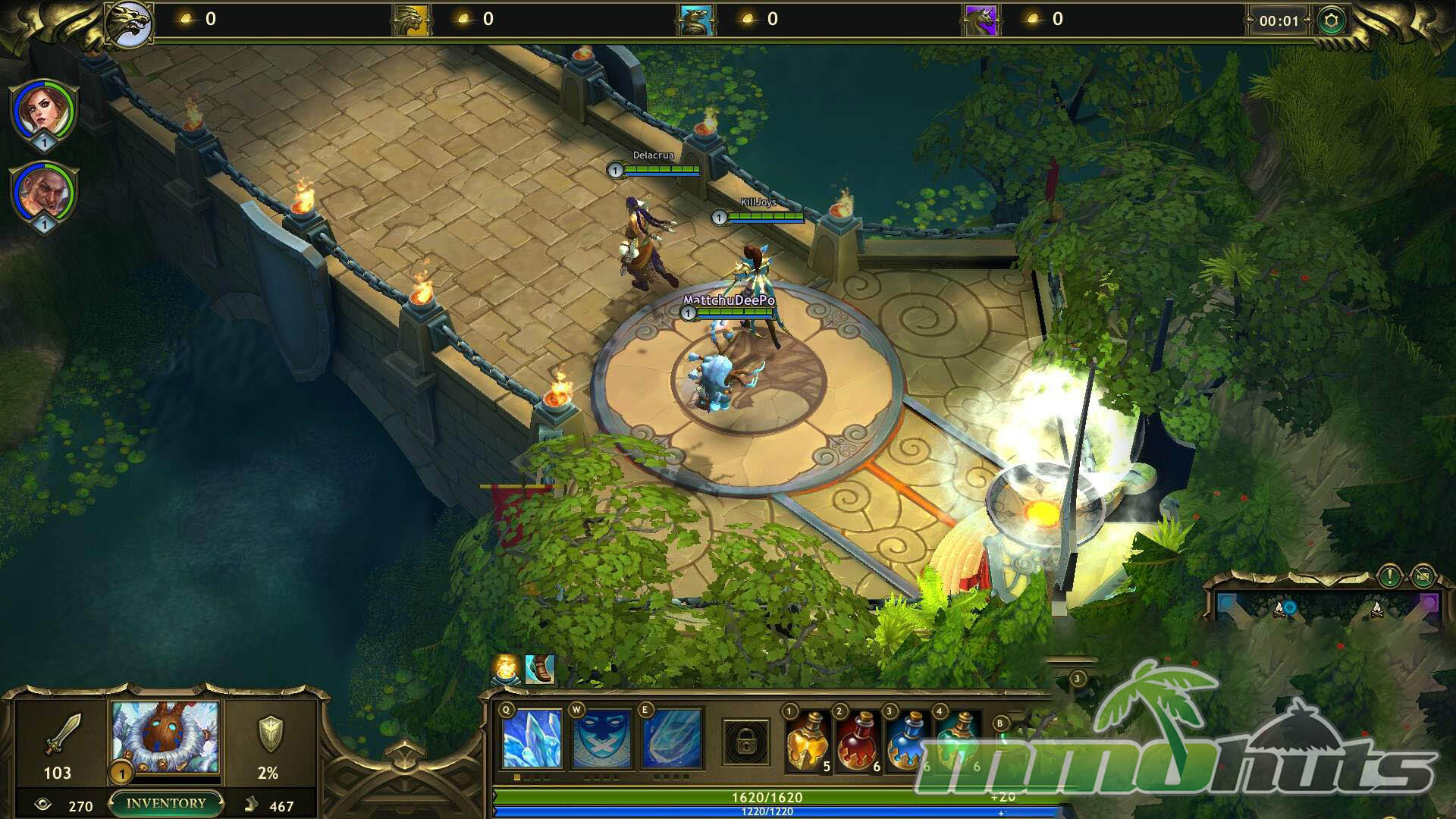
The core play space is the Garden of Heroes, a compact, symmetrical arena where each team spawns at an outer corner. Between each spawn and the center sits a tower that can be captured, and once controlled it periodically generates gold for its owner (in small, steady ticks). The lanes are not the focus here, there is no long march toward an enemy base, and the layout encourages frequent rotations as teams hunt for the next source of income.
Neutral camps fill the map’s quarters and side areas. These function like MOBA jungle camps, but the reward structure is built around gold and chests rather than lane pressure. Many camps are made up of weaker enemies plus a tougher “boss” monster, and defeating the boss can award either a chest worth a chunk of gold or consumable-style sustain items, depending on which camp type is currently active. Camps respawn repeatedly and can change type, which means the best route is not always consistent from match to match.
On the controls side, Golden Rush feels immediately familiar. Movement and targeting behave like a standard top-down MOBA, abilities sit on the QWERTY cluster, “B” recalls, and items map to number keys. The unusual part is kit depth, by default classes only have three skills, and the fourth is tied to acquiring a full artifact set. That design choice makes early matches feel simpler than genre peers, while also tying power spikes to long-term progression outside the match.
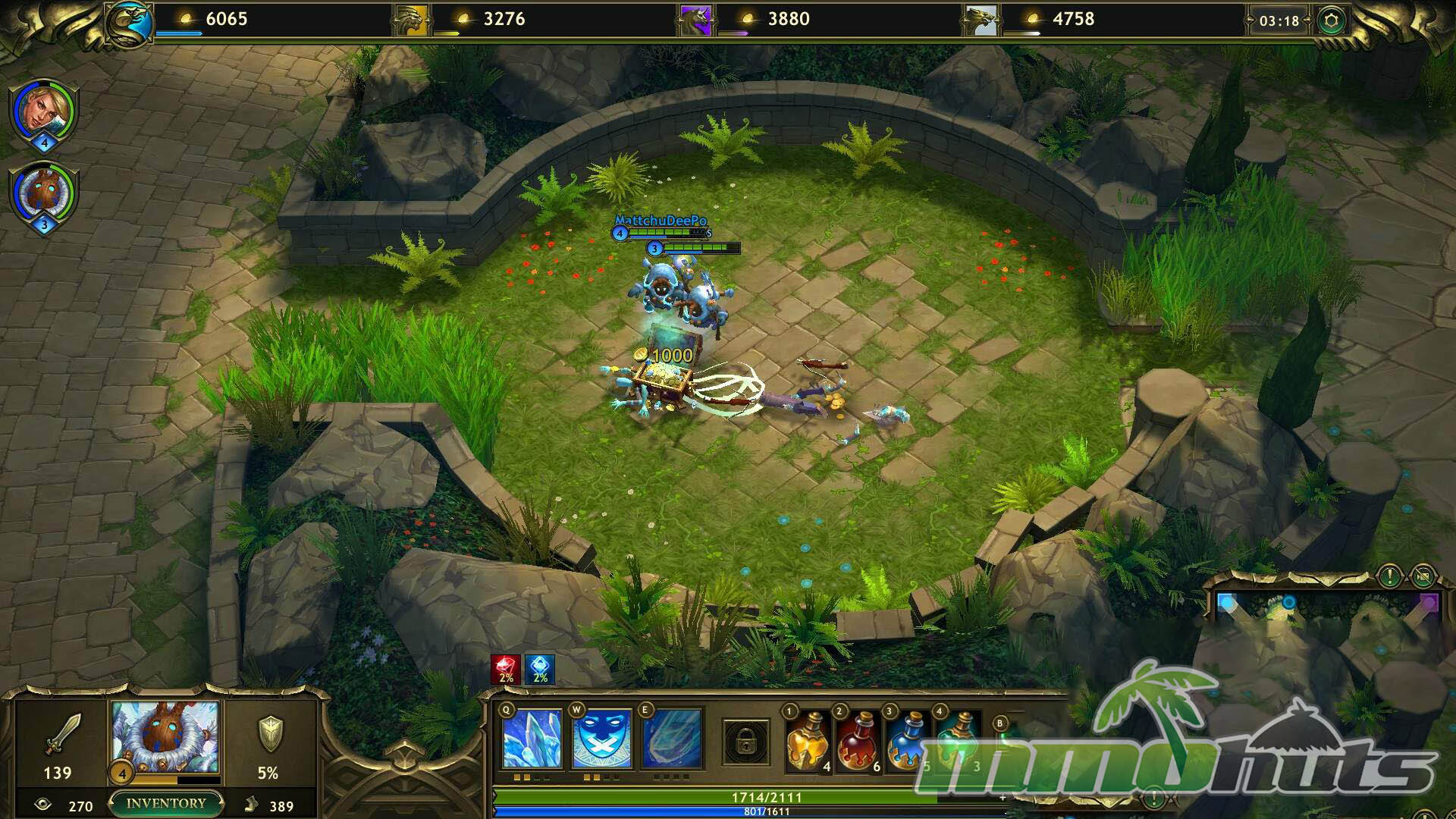
In the primary gold mode, the win condition is straightforward, be the first team to accumulate 30,000 gold. Captured towers provide a baseline income, while camps and chests supply the larger bursts that actually decide games. Two roaming objectives can accelerate the race. The Golden Frog is a mobile source of value that drops gold as it takes damage and awards a 1000 gold chest when killed, but it tries to escape once pressured. The Golden Dragon is the centerpiece PvPvE fight in the middle of the map, dropping a large chest worth 3000 gold and granting a Bone Dragon ally that will circle, capture, and defend a tower.
The second mode, Dragon’s Lair, shifts the focus from raw gold to chest collection. Teams aim to gather twelve chests and keep them safe from theft at their tower. The mode is harsher in terms of PvE difficulty, monsters hit harder and take longer to kill, and the Golden Frog’s reward pattern changes to chest drops across its health segments. There are also map items that are meant to help track down additional chests, although in practice they do not always feel dependable. The biggest practical downside is availability, with such a small population, queues for this mode can stretch beyond ten minutes even at better times, and can stall entirely when too few players are searching.
Match Flow and Decision-Making
On paper, four teams on one map suggests a lot of strategic variety. In practice, the matches tend to funnel players into a narrow pattern: rotate to the best available camp, contest the most valuable chest spawns, pivot to the Golden Frog when it appears, and eventually group for attempts on the Golden Dragon once your team can survive it. Because income is the only real “score,” anything that does not increase your own gold or deny someone else’s tends to feel like a detour.
Aggressively taking enemy towers also has limited payoff in the typical 3-player team context. Holding multiple towers is difficult, and the capture mechanics make solo or small-group takes risky. A single defender stepping into the circle can reset progress, and the tower’s damage is punishing enough that even one opponent arriving at the right moment can turn a capture attempt into a quick death. Add in the short travel time for the closest team to respond, and most tower plays become opportunistic rather than a reliable core plan.
Camps and high-value spawns can also feel inconsistent. Gold camps do not always appear in a predictable rhythm, which creates stretches where teams clear lower-impact camps mainly to gain experience while waiting for better rewards to show up. That variability contributes to a loop where the early and mid game are about farming and skirmishing over the few meaningful objectives, and the late game often becomes repeated, messy fights around the Golden Dragon until one team secures the chest and the tempo advantage.
Design Friction and Balance Issues
Beyond the map flow, several design decisions work against the competitive clarity most MOBA players expect. One example is the Bone Dragon reward. In my experience it did not consistently create a stable advantage because the captured tower still needs players nearby to capitalize on it, and with only three players it is easy to get pulled away by other objectives. There is also the perception of uneven behavior in where the Bone Dragon applies pressure, which can make the “big boss reward” feel less reliable than it should.
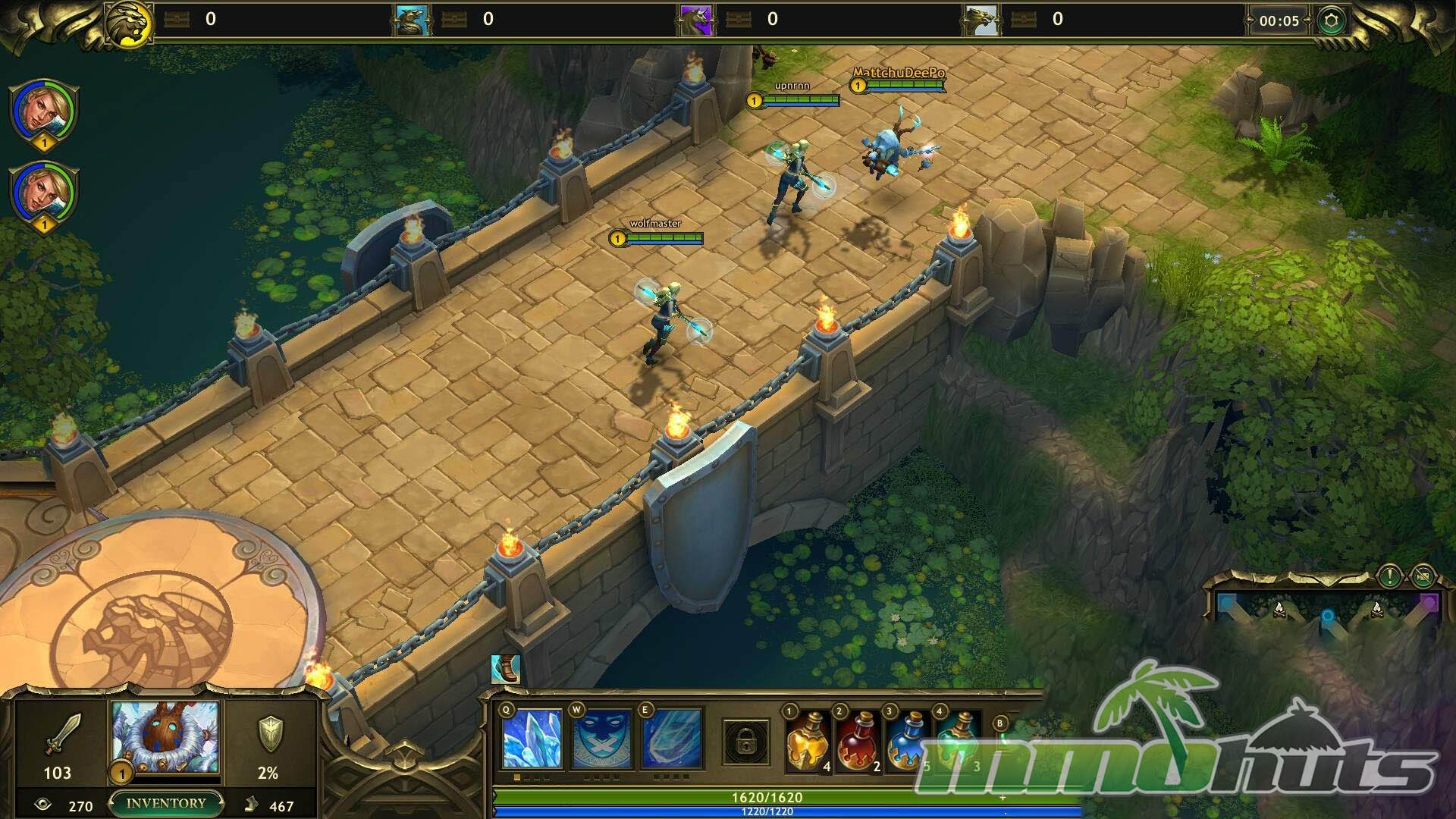
Class kits are another sticking point. Some of the free classes have ability sets that do not feel like they were built around a clear identity or internal synergy. The Mage, for instance, mixes a stationary area damage channel with an area silence and a separate ice-drop ultimate that rewards precise placement. The tools can work, but the overall kit does not naturally guide the player toward a single, coherent game plan.
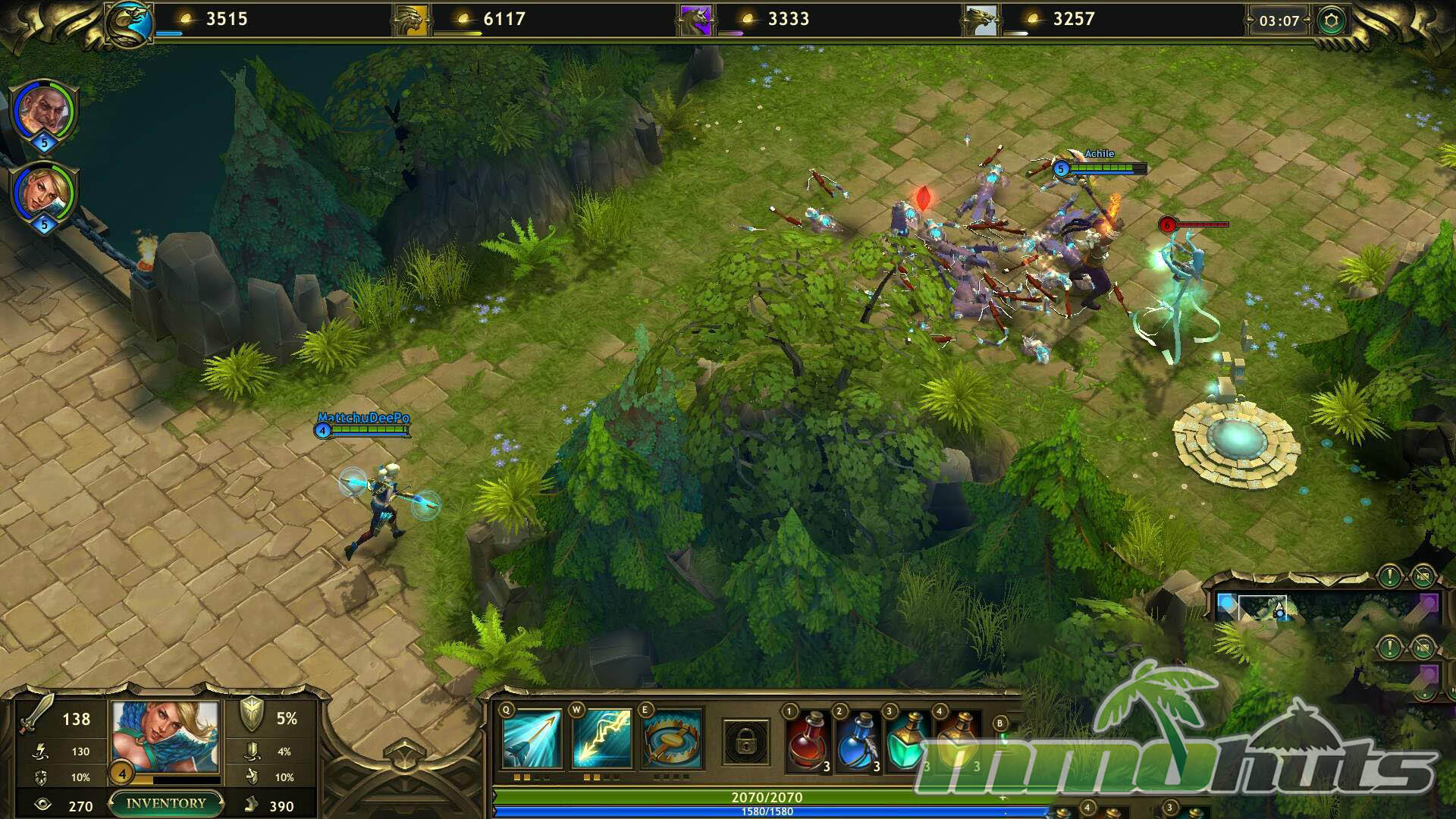
The Archer has a similar issue, a strong line shot, a single-target blind that is hard to evaluate in chaotic fights, and an ultimate that creates an invisible trap for burst damage and a slow. Individually these abilities can be useful, but together they do not strongly reinforce a consistent play pattern the way many MOBA kits do.
Meanwhile, some of the classes that require either payment or extensive grinding appear, at least at face value, to have more naturally powerful combinations. The Witch is a good example, her damage pattern and charm effect suggest a kit that both threatens opponents and creates its own setup, which can feel like a noticeable step up compared to the more awkwardly assembled free options.
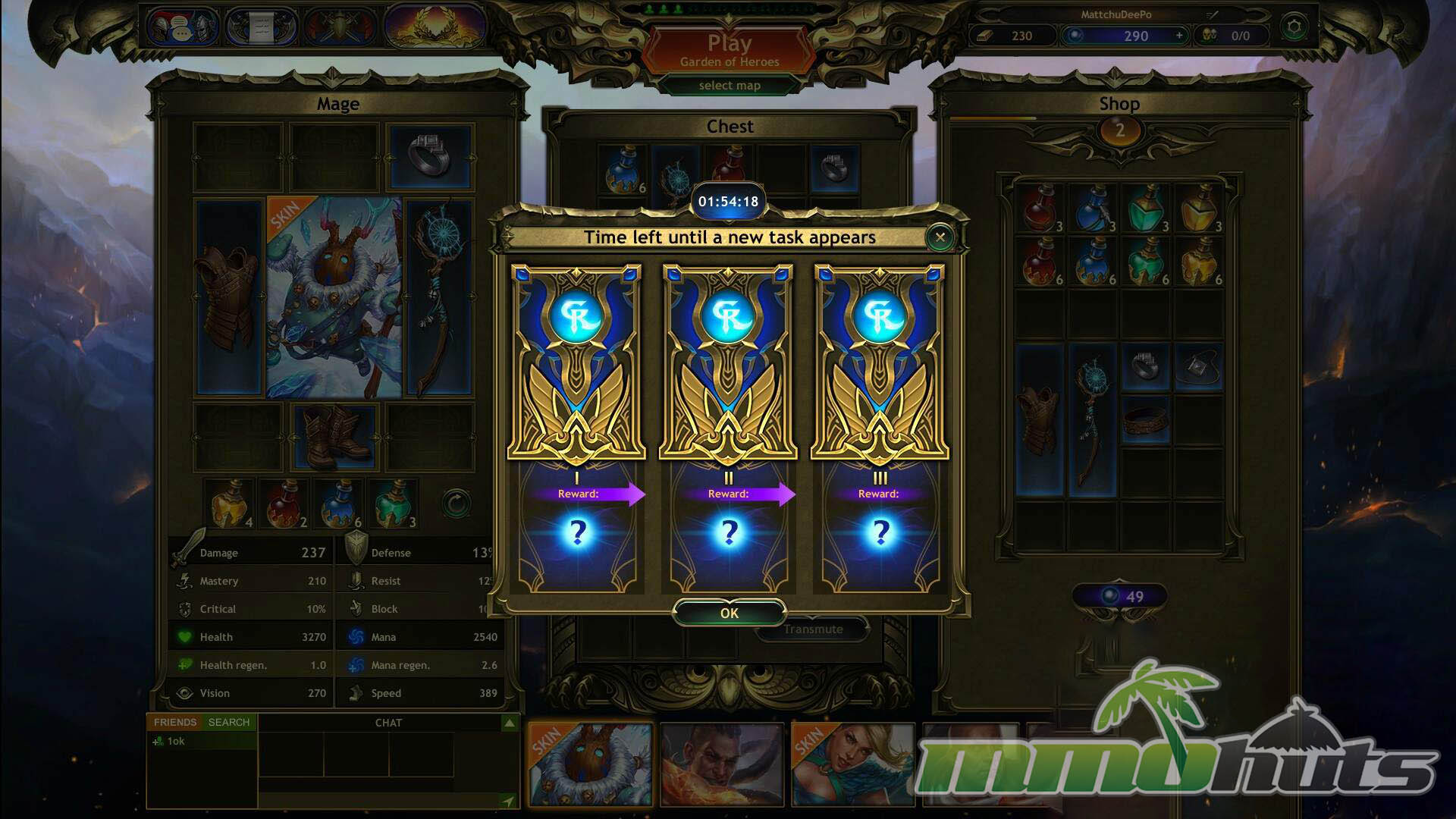
Progression is the other major point of friction. Golden Rush is built around persistent class leveling and stat gear. Each class levels separately, higher levels unlock access to stronger store items, and the store selection is randomized with an option to pay to reroll. Gear can drop during matches, which reinforces the MMO flavor, but the strongest setups still funnel players toward long-term currency accumulation, or toward paying to speed up the process.
Social Experience and Queue Reality
The player behavior in matches is not as explosively toxic as the worst corners of the MOBA genre, and leavers are partially mitigated by bot replacements. The bigger issue is silence. Communication is minimal, and while there is a ping-style objective marker via Ctrl-click, most coordination stops there. With four teams and frequent third-party fights, the lack of shot-calling and shared plans makes matches feel more like parallel solo play than deliberate team competition.
Pay To Win Concerns
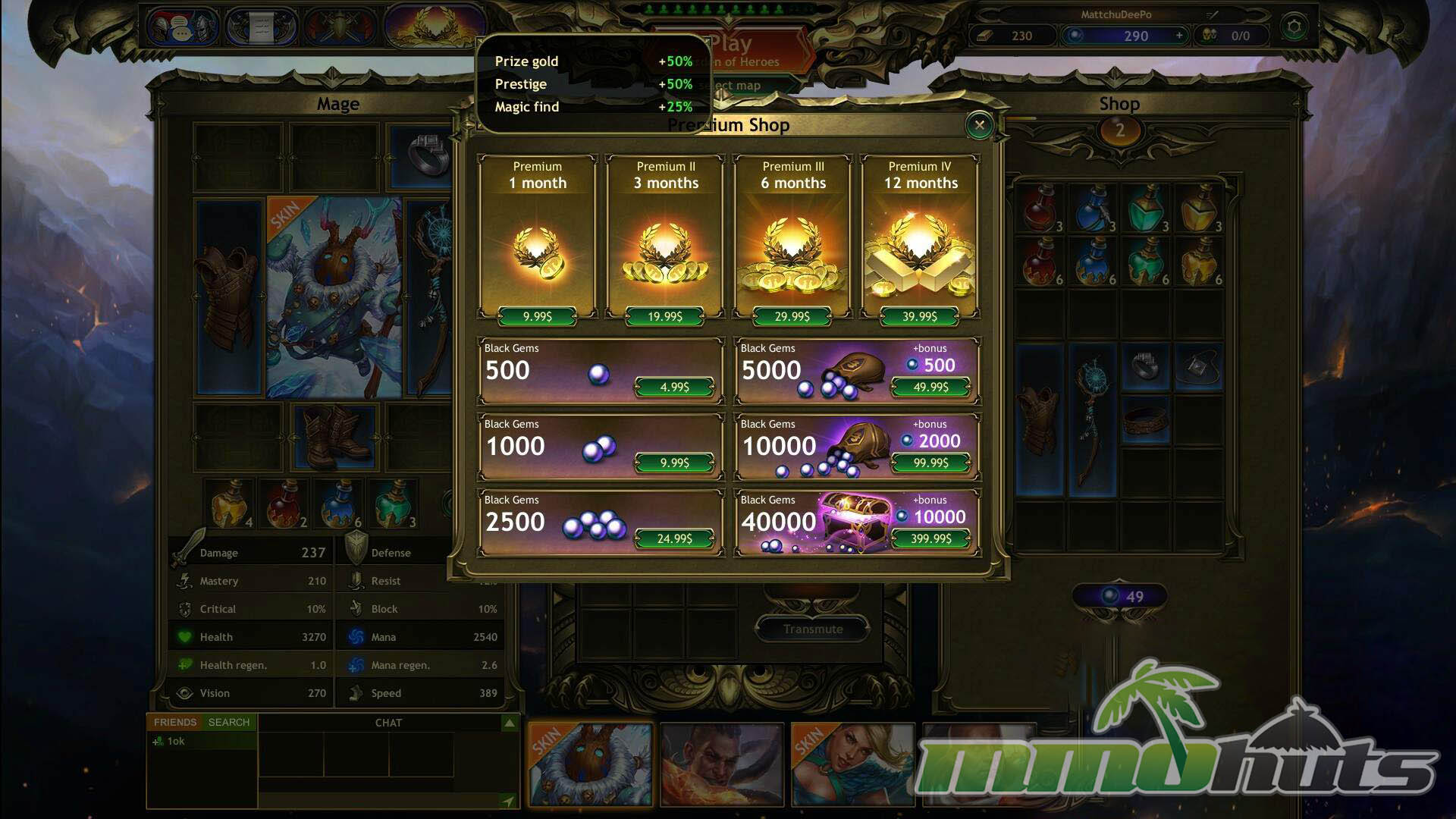
Golden Rush’s business model strongly reflects its developers’ background in long-tail, grind-friendly online games. Black Gems can be purchased for real money and are earned only in small amounts through play, and there is also a subscription that increases the rate you gain experience, Black Gems, and Gold Bars. That alone creates pressure, but the more discouraging monetization is tied to gameplay power.
Unlocking additional classes is a prime example. You can either pay $9.99 or grind out 50 Friend Points while the class is active. Earning those points requires adding someone as an in-game friend through a numeric ID system, grouping with them, then winning matches together. Repeating that process fifty times for a single class is a steep requirement, and the four-team format can make those wins feel even less consistent than in a two-team game.
Skins add another layer of concern because they provide bonuses to base stats and are only available for $9.99. When cosmetics translate directly into stronger characters, competitive integrity suffers, especially in a game already shaped by persistent leveling and gear.
Finally, the artifact-based fourth skill is tied to a high-end set of items. Players can either climb the long ladder of leveling and currency farming (including the Black Gems required for these purchases), or they can reduce that time investment substantially by paying. Even if most items can be earned through normal play, the scale of the grind makes spending money feel less like convenience and more like the practical path to staying competitive.
Final Verdict – Fair
Golden Rush has a few genuine strengths. It runs smoothly, the visuals are pleasant, and the interface is straightforward enough that MOBA veterans can jump in without fighting the UI. The four-team structure is also memorable, and it creates unpredictable fights that you do not often see in the genre.
Where it struggles is in the choices surrounding progression and monetization. Persistent levels, stat gear, and paid advantages (including stat-boosting skins) run counter to what many MOBA players expect from a skill-forward competitive game. On top of that, the class design can feel uneven, and the match flow often collapses into a repetitive objective loop rather than rewarding creative macro play. In the end, it comes across as “unusual” more because it borrows MMO-style systems that most MOBAs avoid than because it refines a new competitive idea. With its extremely low population and eventual shutdown, it is difficult to recommend beyond curiosity value.
Golden Rush System Requirements
Minimum Requirements:
Operating System: Windows XP / Mac OS X 10.7 / Linux
CPU: Intel Celeron E3200 / Athlon X2 6550
Video Card: GeForce GT 6800 / ATI X1800 / Intel HD Graphics 3000
RAM: 2 GB
Hard Disk Space: 200 MB
Golden Rush is Linux and Mac OS X compatible.
Golden Rush Music & Soundtrack
Coming Soon…
Golden Rush Additional Information
Developer(s): Forbes Consult Ltd.
Publisher(s): Elyland Investment Company Ltd.
Engine: Unity
Steam Early Access: September 23rd, 2015
Shut Down Date: September 27, 2018
Development History / Background:
Golden Rush is developed in Unity by the Russian company Forbes Consult Ltd. It is funded and published by Elyland Investment Company Ltd. These companies both worked on My Lands: Black Gem Hunting, along with Gravvit Ltd. Golden Rush takes place in the same universe as My Lands, sharing the Black Gems currency. It was launched into Early Access on September 23, 2015 as a finished game looking for community input.
Golden Rush shut down on September 27, 2018. The game’s shut down wasn’t surprising as the game’s playerbase has been extremely low ever since it launched.