Battlefield Play4Free was a free-to-play entry in the Battlefield franchise that aimed to deliver a familiar Battlefield 2 style experience in a browser-friendly package, complete with classic class roles, large maps, and 32-player combined arms matches, funded through ads and microtransactions.
 | Publisher: Electronic Arts Type: Shooter Release Date (Open Beta): April 4, 2011 Closure Date: July 14, 2015 Pros: +Authentic Battlefield scale and flow. +Distinct class roles and team play. +Quick, action-forward pacing. Cons: -Freemium balance could feel pay-to-win. -Movement and handling sometimes felt stiff. |
Battlefield Play4Free Overview
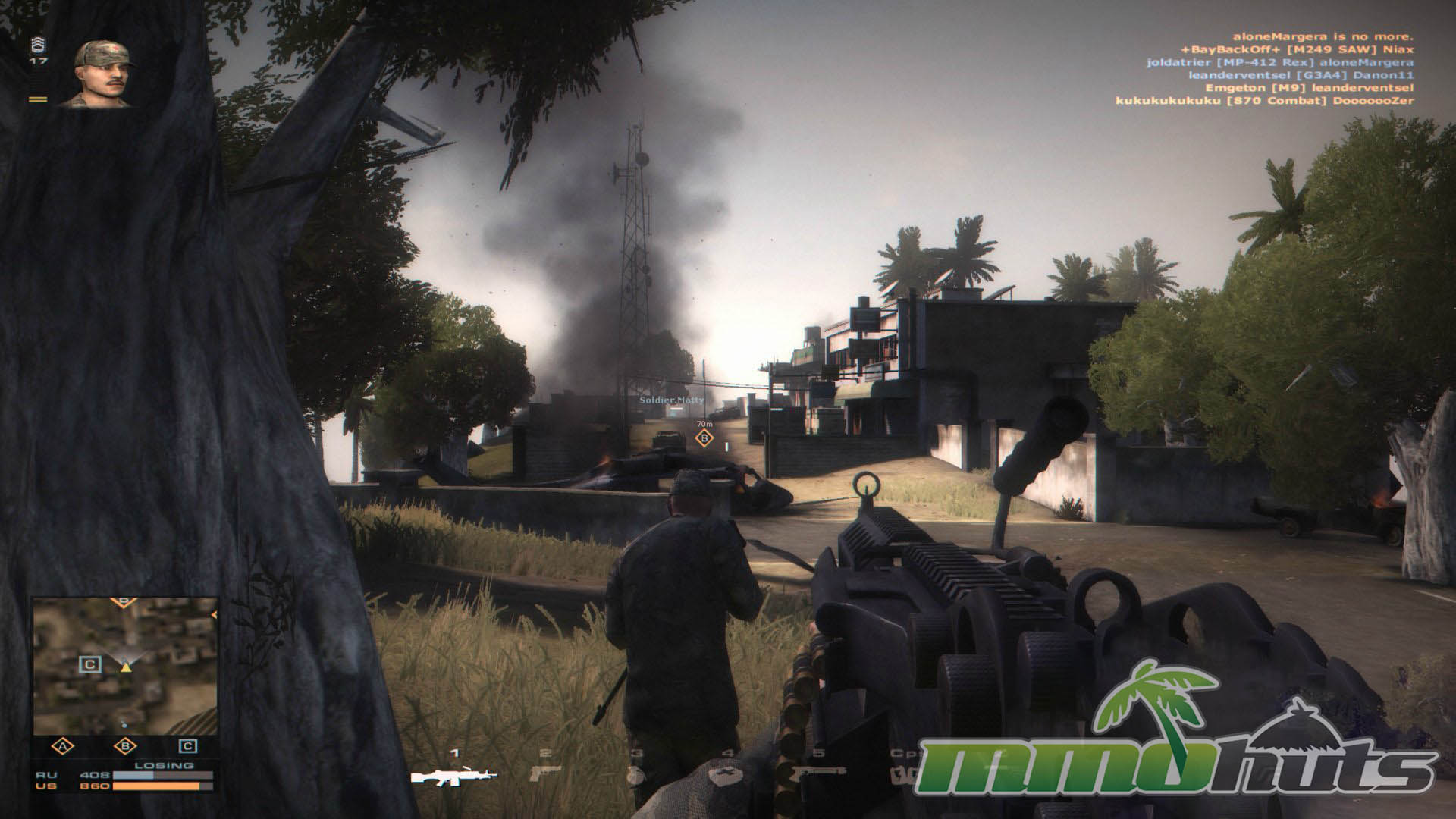
Battlefield Play4Free was an MMO-flavored first-person shooter that repackaged much of the Battlefield 2 formula into EA’s “Play 4 Free” lineup. Instead of a traditional box price, it relied on microtransactions and advertising, which influenced how progression and equipment were presented. Under the hood, it ran on a modified version of Battlefield 2’s Refractor 2 technology, so the gunplay, hit feedback, and general feel were deliberately close to BF2, while the visuals were touched up to look more modern than the 2005 original.
Where it separated itself from Battlefield 2 was in the metagame. Alongside the classic Battlefield loop of capturing flags and pushing objectives, Play4Free introduced a leveling system and unlock structure reminiscent of Battlefield Heroes. Players gained experience, invested points into a Training tree, and used an in-game store to customize their loadouts. That added a light RPG layer, but it also meant that the grind and shop offerings were a constant part of the experience.
Matches revolved around the series’ familiar four-class setup: Assault, Medic, Engineer, and Recon. After choosing a role, players were dropped into battles on a rotation of eight maps, fighting as either the Russian Ground Forces or the United States Marine Corps. Overall, it played like a free-to-play remix of Battlefield 2, with some Bad Company 2 era influence in presentation, updated graphics, and freemium progression systems layered on top.
Battlefield Play4Free Key Features:
- Four Playable Classes (Assault, Medic, Engineer, Recon) – Choose a core combat role and contribute through frontline pressure, healing, repairs, or scouting and long-range picks.
- Maps from Battlefield 2 – Battle across six classic BF2 locations plus two original maps, supporting up to 32 players in the same match.
- Multiple Game Modes – Jump between Conquest, Conquest Assault, and Rush for different objective structures and pacing.
- Collectible Weapons– Build out an arsenal featuring weapons from BF2 and BFBC2, with certain options restricted by class or unlocked through training.
- RPG Elements — Earn experience and spend points in the Training tree to open up new gadgets, weapon access, and character abilities over time.
Battlefield Play4Free Screenshots
Battlefield Play4Free Featured Video

Battlefield Play4Free Online Links
Battlefield Play4Free Wikipedia Page
Battlefield Play4Free Wikia (Database / Guides)
Battlefield Play4Free Metacritic (Reviews)
Battlefield Play4Free Music & Soundtrack
Coming soon…
Battlefield Play4Free Additional Information
Developer(s): EA Digital Illusions CE, Easy Studios
Publisher(s): Electronic Arts
Designer: Colin Clarke
Game Engine: Refractor 2 Engine
Closed Beta Date: November 30, 2010
Open Beta Date: April 4, 2011
Closure Date: July 14, 2015
Battlefield Play4Free began development at EA Digital Illusions CE, with Easy Studios later taking on further development work. Electronic Arts published it under the “Play 4 Free” umbrella, the same business initiative that also included titles like Battlefield Heroes and Need for Speed: World. Access initially rolled out via an email-based closed beta that started on November 30, 2010, before transitioning into open beta on April 4, 2011.
Notably, the game never received a distinct “full release” date beyond that open beta milestone. Like the rest of EA’s Play 4 Free catalog, it ultimately shut down on July 14, 2015, a decision tied to shrinking populations across the model’s games and the difficulty of sustaining them long term.