
March Of War: Face Off
March of War: Face Off blends the accessibility of a digital card battler with the positioning decisions of a compact, turn-based tactics game. Instead of racing to reduce a hero’s health directly, you win by advancing units across a small battlefield and turning territorial pressure into damage, which gives each match a quick, momentum-driven feel.
|
Publisher: ISOTX Playerbase: Shut Down Type: Turn-based strategy Release Date: July 16, 2015 Shut Down: March 29, 2016 Pros: +Simple rules, quick to start playing. +Matches emphasize tempo and smart positioning. +Large pool of cards to collect and experiment with. Cons: -Early progression does not clearly guide players toward earning new cards. -Battlefield visuals and environments feel samey. -Common packs often produce many duplicates across players. -Unit designs can blur together, reducing meaningful variety. |
March of War: Face Off Overview
March of War: Face Off is a free-to-play spin-off from ISOTX (the team behind Iron Grip: Warlord) that tries to meet two audiences in the middle. It uses the familiar draw-play-turn flow of modern collectible card games, then adds a grid-based battlefield where movement and lane control matter as much as raw stats. The central twist is how you deal damage: instead of attacking a commander directly, you score by pushing units deeper into enemy territory, converting board position into damage through Domination Points.
Decks are built around two factions and a mix of unit cards and Command (support) cards. In practice, that means balancing bodies that can advance quickly with heavier pieces that take over once the board stabilizes. March of War: Face Off shut down in March, 2016.
March of War: Face Off Key Features:
- Fast-paced gameplay – matches are quick, typically taking 10-15 minutes.
- Two Game Genres: A mix of collectible card games and tile-based strategy games, build your deck and then lead your chosen units on the battlefield.
- Two factions – pick one of two factions, each with their own command center and cards.
- Huge card library – make a deck of thirty cards from over 220 different cards.
- PvP and PvE matches – play against the computer or climb the PvP ladder by playing against other players.
March of War: Face Off Screenshots




March of War: Face Off Featured Video

March of War: Face Off Review
Digital card games exploded around the time March of War: Face Off arrived, and many of them fell into clear camps. Some chased the complexity of long-established tabletop systems, others leaned into streamlined, “easy turn” play, and a third group tried to merge card play with tactics on a board. March of War: Face Off sits in that hybrid space alongside other lane-and-grid experiments, aiming for quick matches and readable decision-making rather than deep, sprawling rulesets.
Gameplay
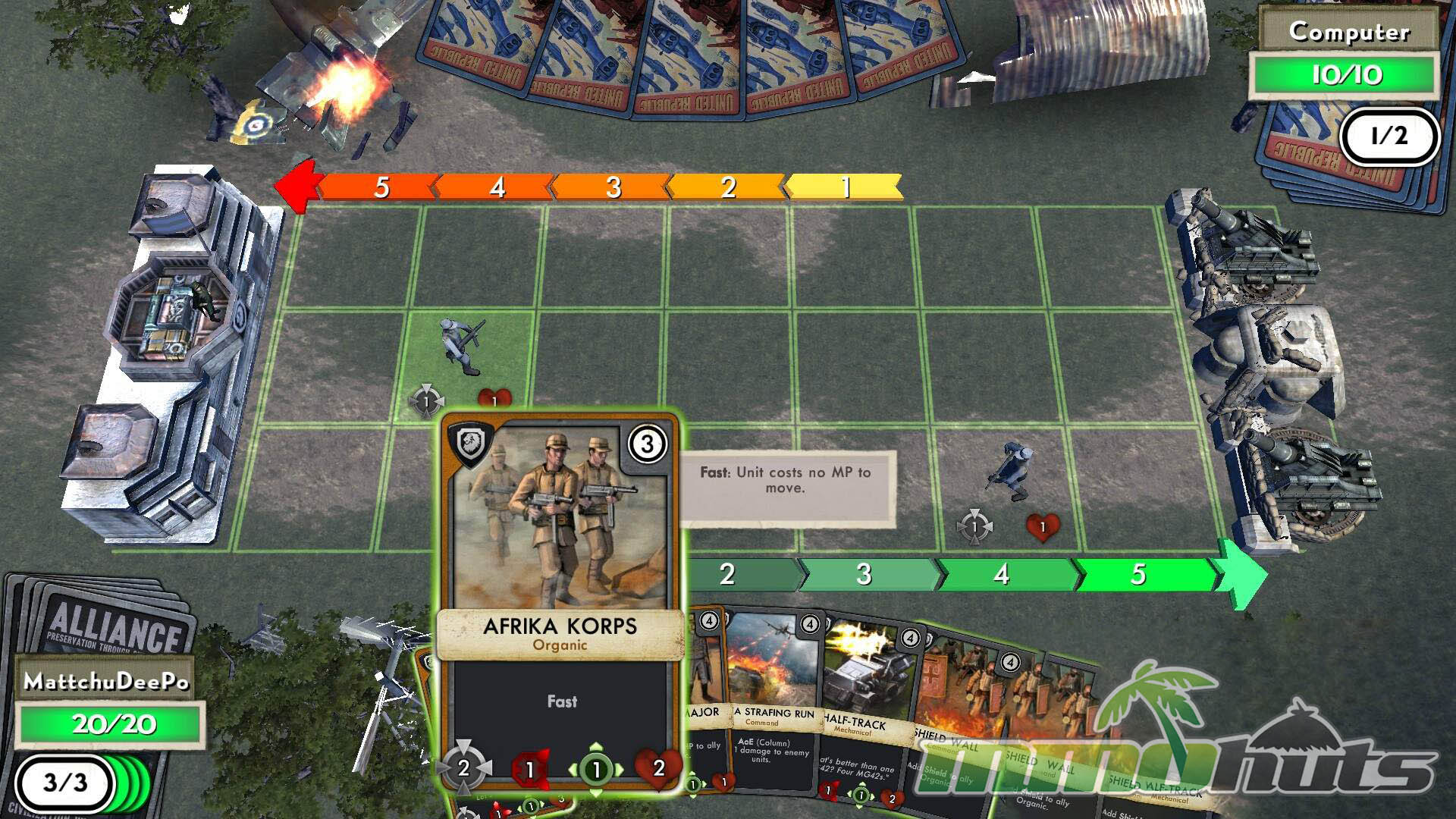
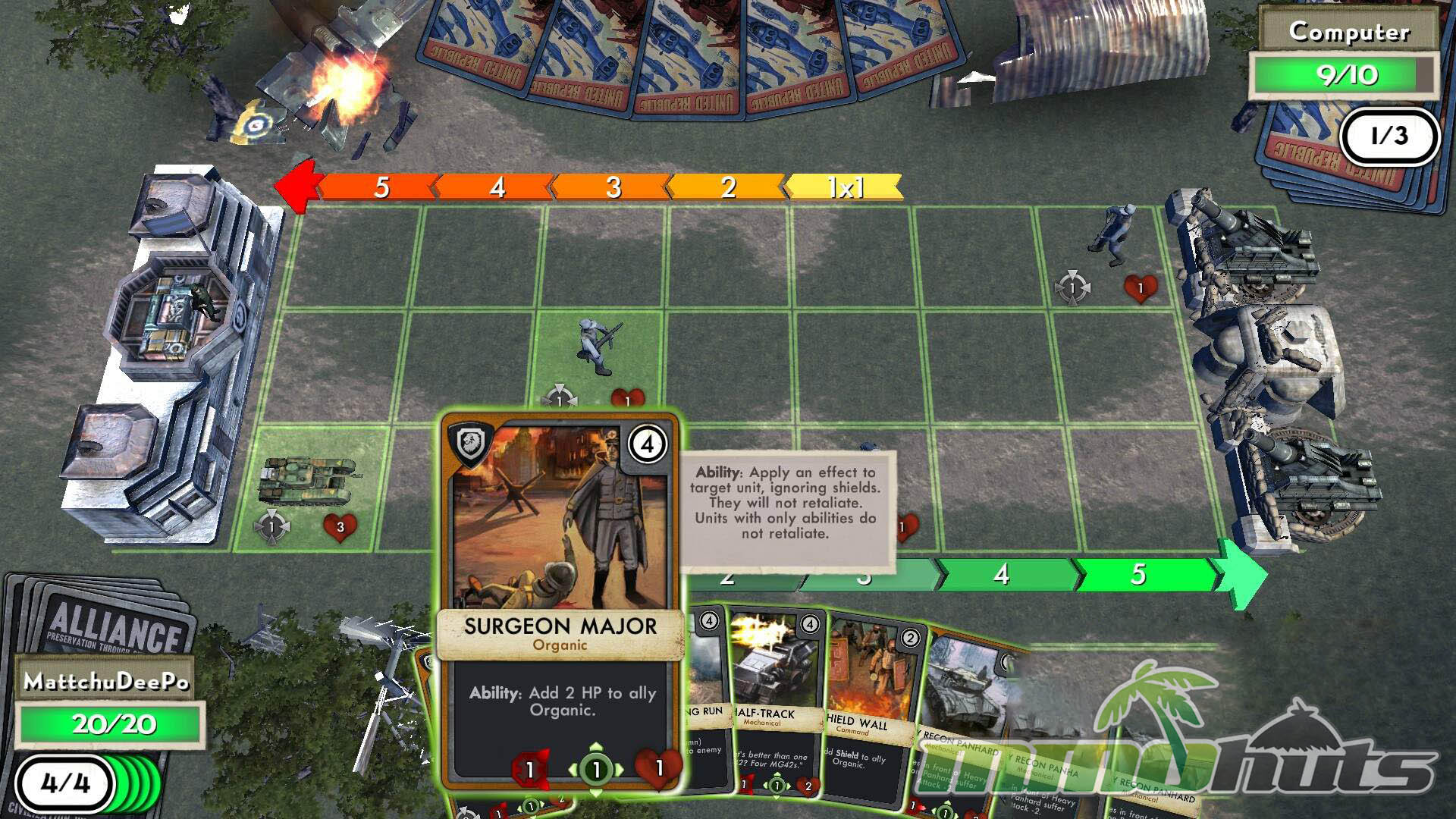
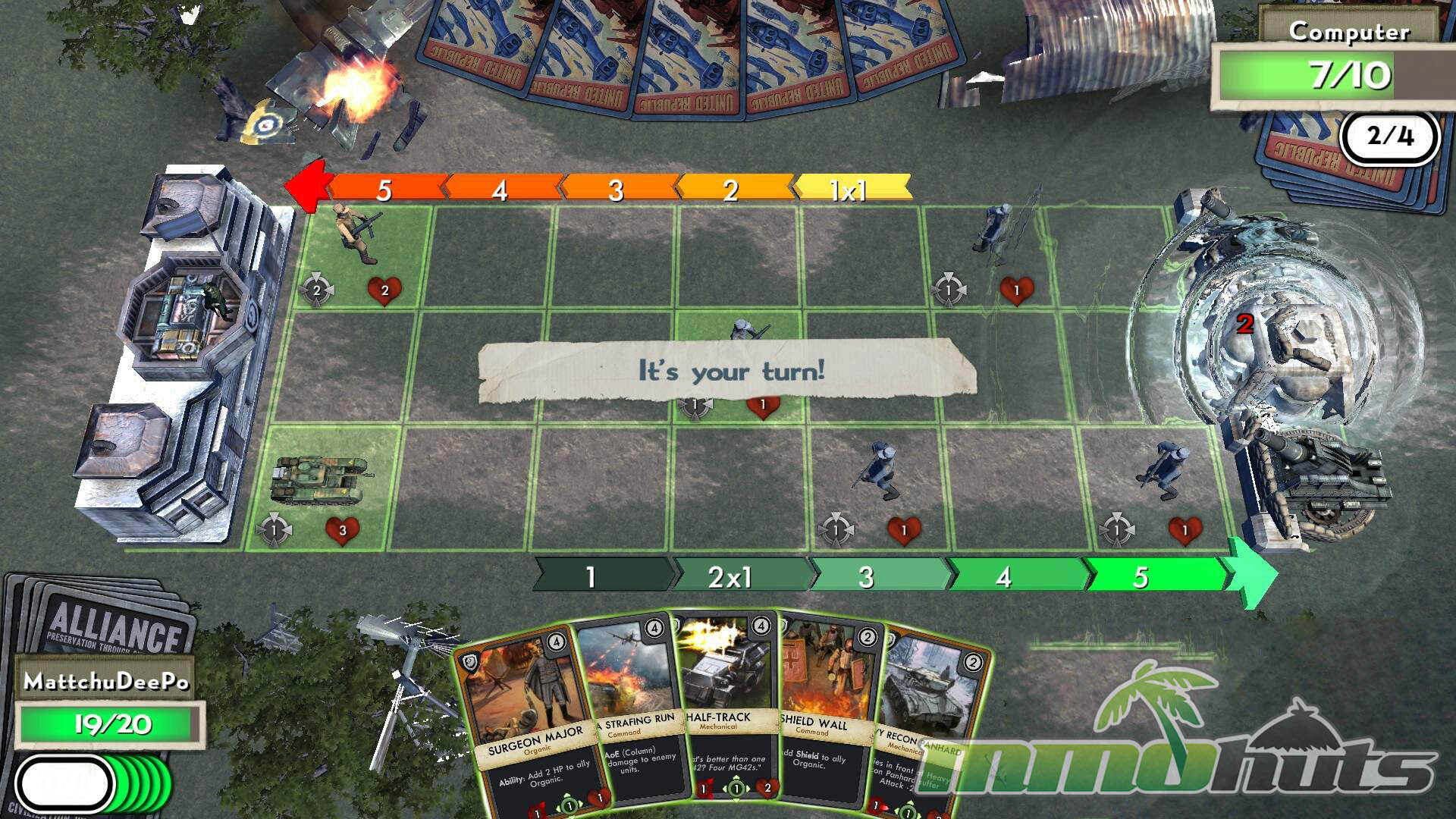
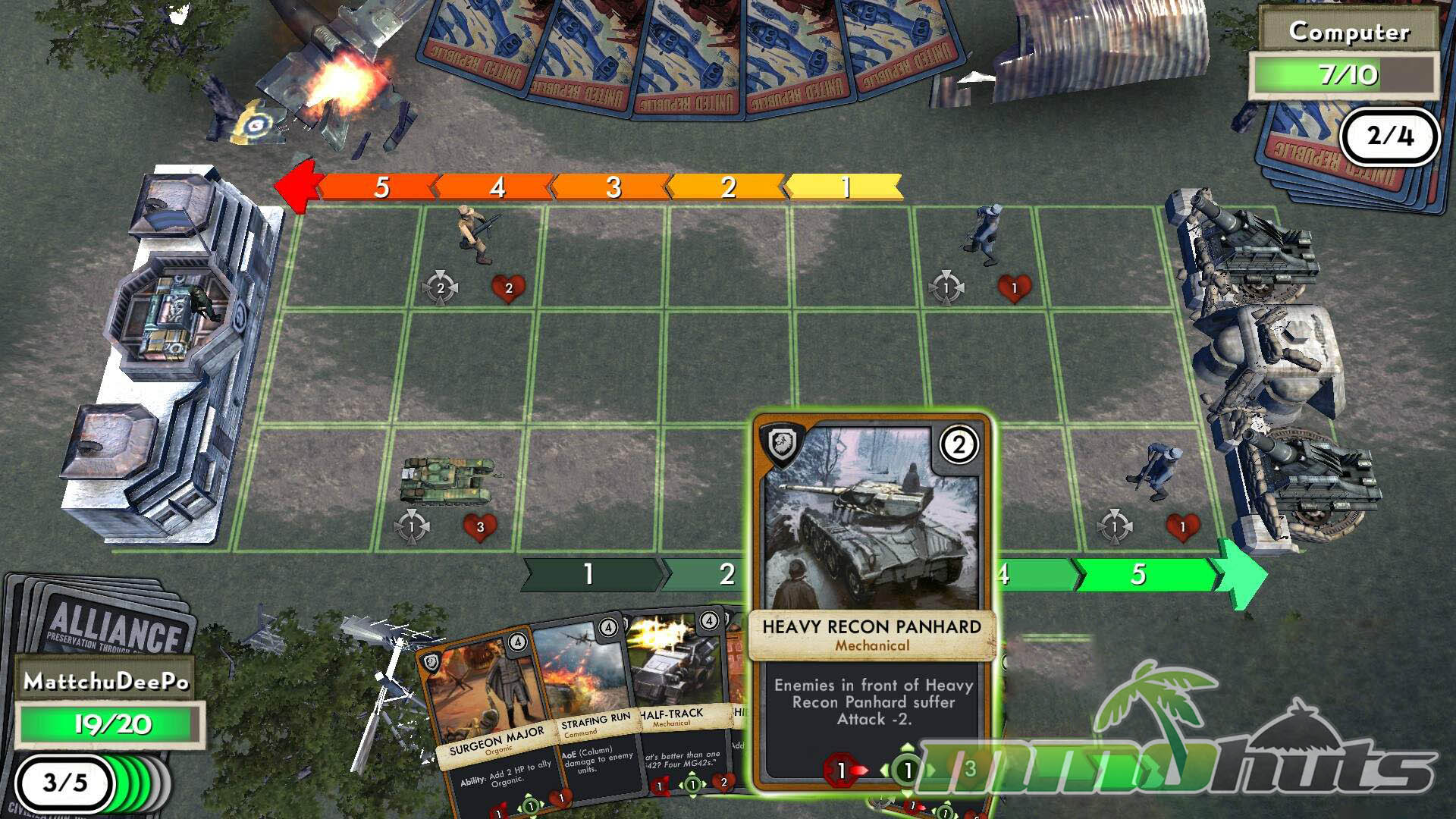
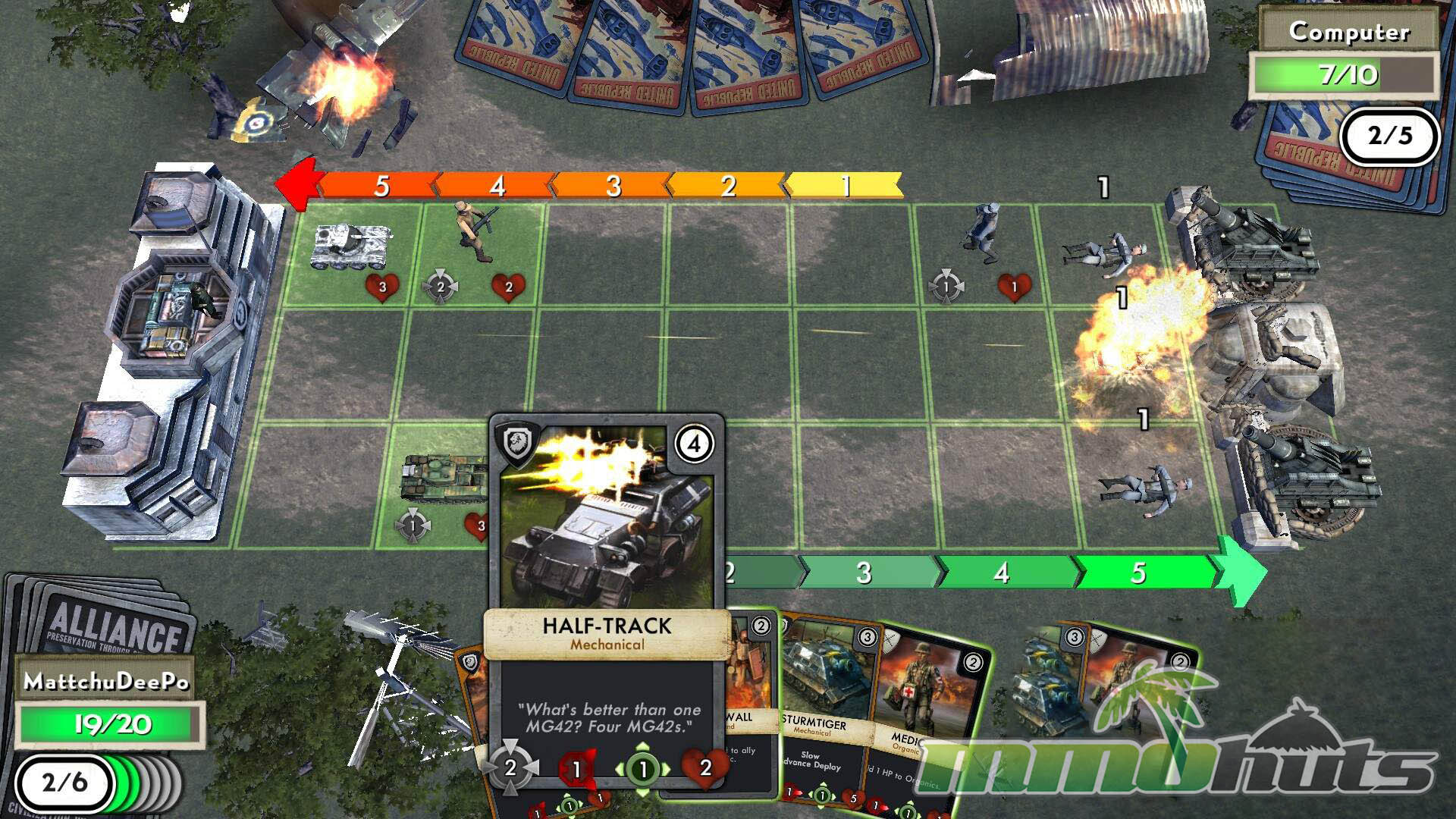
The entire match plays out on a simple three-by-seven grid with a Command Center at each end. The UI communicates the win condition clearly: the columns toward your opponent’s side are tied to Domination Points, which translate into damage against the enemy Command Center when your turn begins. In other words, territory is the weapon, and merely surviving is not enough if you are not advancing.
Your hand sits along the bottom, deck information is a hover away, and the resource system is a close cousin of “mana” from other card battlers, here renamed to Manpower. You ramp up by one Manpower per turn to a cap of 12, which creates a familiar cadence of early skirmish units into late-game power plays. The second player also receives a one-turn resource boost card, a common solution for tempo disadvantage that works well in a game where initiative can snowball.
What makes matches feel different from a pure CCG is that damage is largely indirect. You are constantly weighing whether it is better to trade pieces or to spend those turns moving forward to increase your Domination Points. Because damage scales with how far units penetrate, many turns are about forcing awkward blocks, accepting losses, and keeping just enough presence to maintain the push. Stopping the opponent matters, but it is often a means to protect your own advance rather than the primary route to victory.
The World War II inspired theme fits the tempo-first design surprisingly well. Many games play like a series of short, sharp pushes, with support cards (artillery, air support style effects) acting as cleanup tools once units are low or clustered. As resources climb, the board tends to shift toward armored threats, and heavier units can dominate lanes that lighter infantry cannot realistically hold without help.
Tactical Variety
For a hybrid card-and-tactics game, March of War: Face Off can feel narrower than you would expect, particularly at the start. The early decks for both factions share a large overlap of general cards, so your first dozen matches often feature similar openings and similarly shaped turns. As you expand your collection, you gain more ways to tune the pacing and to specialize, but the fundamental loop, advance quickly, manage trades, then leverage support cards, stays largely intact.
A big part of decision-making revolves around attributes that interact with Manpower over multiple turns. Movement costs and movement modifiers strongly influence whether a unit is actually “cheap” in practice. Cards tagged with Slow can become resource sinks because advancing them demands extra Manpower across turns, and the payoff is not always dramatically higher stats. By contrast, Fast units can keep pressure on while letting you spend Manpower on additional plays, which is crucial in a game where board position converts into damage. Attacking itself does not consume Manpower, which is normal for the genre, but the naming and theme can make it feel slightly unintuitive at first.
Medics also define a lot of early play. They cannot attack, yet they still contribute to Domination Points, and their ability to repeatedly heal a friendly unit each turn can turn disposable bodies into stubborn blockers or surprisingly durable push pieces. Because their healing can stack beyond a unit’s baseline health, they become one of the clearest “engine” style tools available early on, and much of the tactical play is about protecting them or eliminating the opponent’s medic at the right moment.
There are more specialized unit patterns, such as stationary defenses, diagonal attackers that evoke chess-like positioning, and units that begin with reduced attack due to entrenchment style drawbacks. However, these are less common than straightforward infantry-to-vehicle stat lines with minor movement tweaks. The widest variety tends to come from Command cards, yet even there many effects land in similar buckets (damage, healing, displacement). When a card meaningfully changes the resource math, such as converting Manpower in a favorable way for a turn, it stands out because it creates a different kind of planning than the usual “play unit, move unit, support unit” rhythm.
Progression
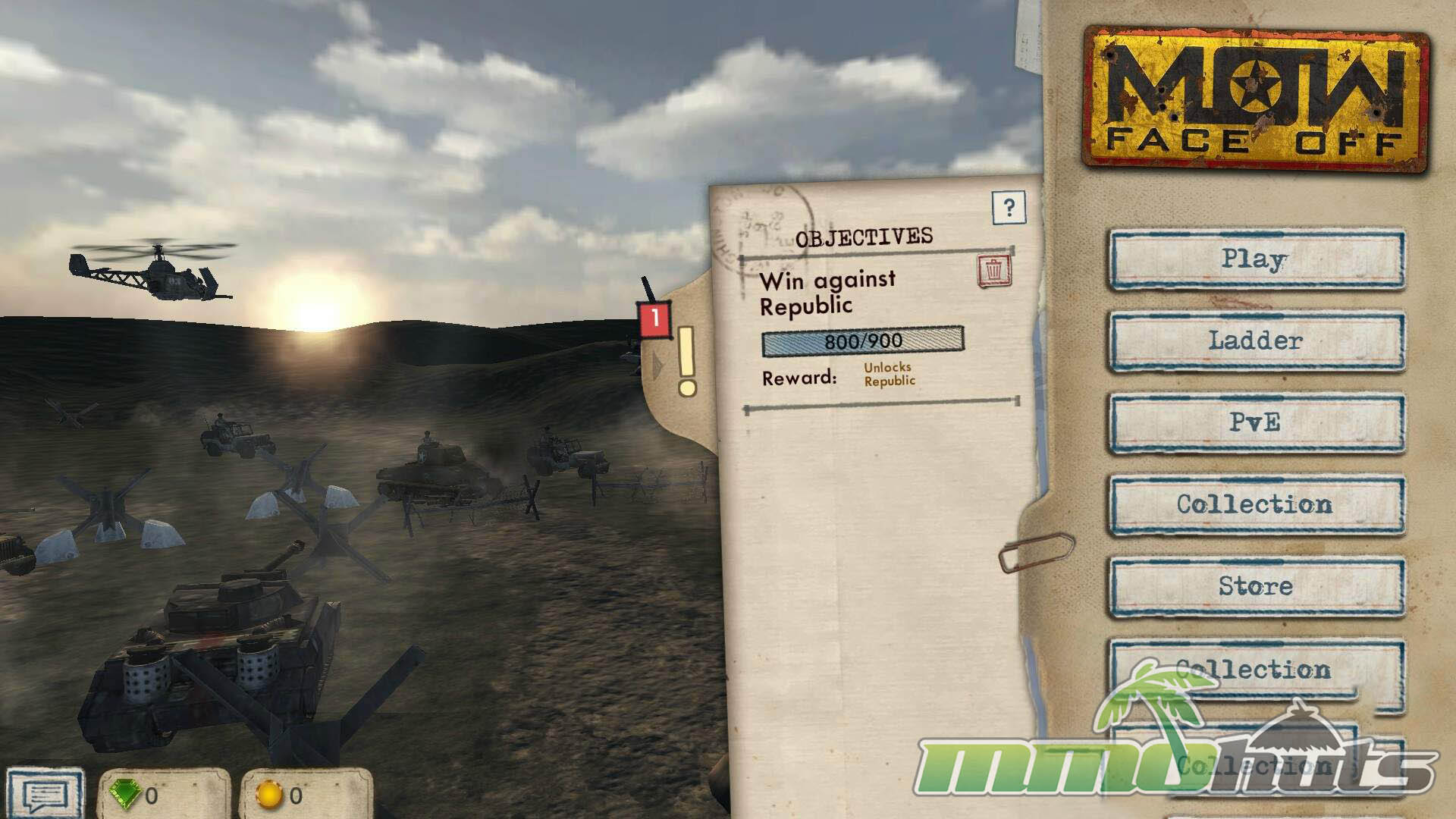
Progression is where March of War: Face Off feels least polished. Like other CCG-style games, you level factions and unlock cards along the way, and there are objectives that award gold for packs. The issue is not that rewards do not exist, it is that they are not communicated in a way that lets players plan. The initial objective can be generous and also functions as a gateway to unlocking the other faction, but once you clear that first step the game does not do a great job of telling you what to chase next.
Instead, many rewards arrive as if they were discovered accidentally, a small payout for a specific action, or a larger first-time bonus for a PvP win, without a clear list of goals to pursue. That design makes early play feel like you are waiting for the game to acknowledge progress rather than deliberately working toward it. For new players, a more transparent set of starter challenges, especially ones that encourage trying different unit types and Command cards, would have helped the learning curve and made the first sessions feel more directed.
The card economy can also be slow to open up. It is possible to spend a solid block of early play time and end up with only a few common packs, and those packs frequently contain duplicates, including repeats of cards you already have through starter decks. Multiple players pulling very similar results reinforces the sense that the “common” pool is narrow. If you want a chance at higher tier cards, you are pushed toward more expensive packs (including faction-focused options), which can take a while to afford through normal play, or can be purchased directly for real money.
The upside is that the starter decks contain some of the more generally useful Command tools, so you are not completely locked out of functional strategies. Still, the overall collection size and the way many units overlap in role can make the chase for new cards feel less exciting than it should. The PvP ladder is present and provides a long-term climb, but it is largely a background progression track rather than a system that actively changes how you play from week to week.
Presentation
Visually, March of War: Face Off gets the job done, but it rarely impresses. The art direction leans into muted, battlefield-like tones, which supports the theme, yet it also contributes to a sense of sameness because the board and background do not vary much. With only two factions, you see the same command centers and the same faction card backs repeatedly, and there are no additional card backs to earn or collect, which removes a small but meaningful personalization hook that other card games use effectively.
The in-match interface is readable and functional, but the menus feel more like a touch-first layout than a PC-native UI. Oversized buttons and awkward scrolling behavior can make navigation feel clunky. Some actions rely heavily on click-and-drag, including common tasks like deploying units or deck management, and the tutorial’s “tap/click” language reinforces the impression that the interface was built with portability in mind.
Audio is another weak point. The soundscape is serviceable when it is working, but it can be inconsistent. Music dropping out unexpectedly leaves long stretches with only sparse effects and short, frequently repeated voice lines. On top of that, some actions occasionally lack sound feedback, which makes the match feel flatter than it should, even for a genre where audio is not the main draw.
Connection stability also impacts the experience. Depending on where you are playing from relative to the servers, turn transitions can sometimes take an uncomfortably long time, and occasional disconnect messages can appear even when the match resumes moments later. For a game designed around brisk, 10 to 15 minute matches, those delays are especially noticeable.
Final Verdict – Good
March of War: Face Off has a solid core idea and executes it competently. The indirect damage system, where advancement equals pressure, creates matches that move quickly and reward decisive play. It also serves as a relatively approachable entry point into the “cards plus tactics” subgenre, offering a lighter, faster alternative to more feature-heavy competitors.
At the same time, the game struggles to provide a compelling long-term structure. Early progression is not clearly signposted, card acquisition can feel unrewarding due to duplicates and unclear objectives, and the tactical space can narrow as many units occupy similar roles. Add in modest presentation, limited customization, and occasional connectivity frustrations, and the result is a game that works best in short sessions rather than as a deep hobby title. For players who enjoy quick PvP matches and a straightforward push-and-punish board game loop, it offers enjoyable moments, but it is easiest to recommend as a casual experience.
March of War: Face Off Links
March of War: Face Off Steam Store
March of War: Face Off Developer’s Website
March of War: Face Off System Requirements
Minimum Requirements:
Operating System: Windows Vista, Windows 7 or Windows 8
CPU: Intel Core 2 Duo E4600 2.4 GHz AMD Athlon 64 X2 Duel Core 5200+
Video Card: nVidia GeForce 7 series or ATI Radeon HD 2000
RAM: 4 GB
Hard Disk Space: 1 GB
Recommended Requirements:
Operating System: Windows 7 Service Pack 1 64-Bit
CPU: Mid to High Range Dual-Core 2.5GHz CPU
Video Card: Nvidia GeForce GTX 285 or AMD Radeon HD 5830
RAM: 8 GB
Hard Disk Space: 1 GB
March of War: Face Off is Mac OS X compatible.
March of War: Face Off Music & Soundtrack
Coming Soon…
March of War: Face Off Additional Information
Developer(s): ISOTX
Publisher(s): ISOTX
Engine: Unity
Steam Early Access: April 10, 2015
Release Date: July 16, 2015
Steam Release Date: July 16, 2015
Shut Down: March 29, 2016
Development History / Background:
March of War: Face Off was built in Unity by Dutch developer ISOTX as a smaller, card-focused offshoot of their MMO turn-based strategy title March of War. It launched into Steam Early Access on April 10, 2015, then moved to a full release on July 16, 2015 after roughly three months in Early Access. In March, 2016 the game shut down without a formal public announcement, effectively vanishing from service.